The marvelous journey of Tinoq Russell Goh continues. Up next, a collaboration with a bistro in Paris, come October
A TikTok and an Instagram video of the “chef” and food business PasirPanjangBoy (PPB) were recently shared on the account 8 Days Eat (part of the 8 Days e-mag). Circulating among social media users this past week, the reels introduced the latest hawker stall Masala Curry Noodles that PasirPanjangBoy, aka Tinoq Russell Goh (TRG)—also a makeup artist, has set up at the Havelock Road Cooked Food Centre. This is his second hawker stall after his first, Masala Canteen, opened last year at Beo Crescent Market, just two hundred and fifty metres away. He told curious customers then that he was “doing it for a friend”. That, in fact, is his businesses and together with the other two are within a 120-metre radius of his Bukit Ho Swee home, where he operates a private diner that in 2018 fast-tracked him to considerable fame outside the fashion industry.
In this past week, also circulating through social media is TRG revealing that he will be off to Paris in October to collaborate with a Parisian bistro. Chatter online pointed to the small Asian establishment The Hood. This would be his second overseas collaboration through PPB after their short stint with Bibi & Baba in Hong Kong in 2020. Situated in buzzing Wan Chai, Bibi & Baba—now closed—is a Peranakan eaterie of the JIA Group, founded by Singaporean hospitality maestro Yenn Wong. PPB’s pairing with The Hood is reminiscent of their Hong Kong foray in that the hipster bistro in the 11th arrondissement is co-founded by another Singaporean woman, Pearlyn Lee. It is not yet clear what dishes the collaboration would yield, but it is unlikely that an entire new menu would be conceived, as TRG did for Bibi & Baba. At the time, a Singaporean working in Hong Kong told us that the food was “strictly for those who desperately miss home”.
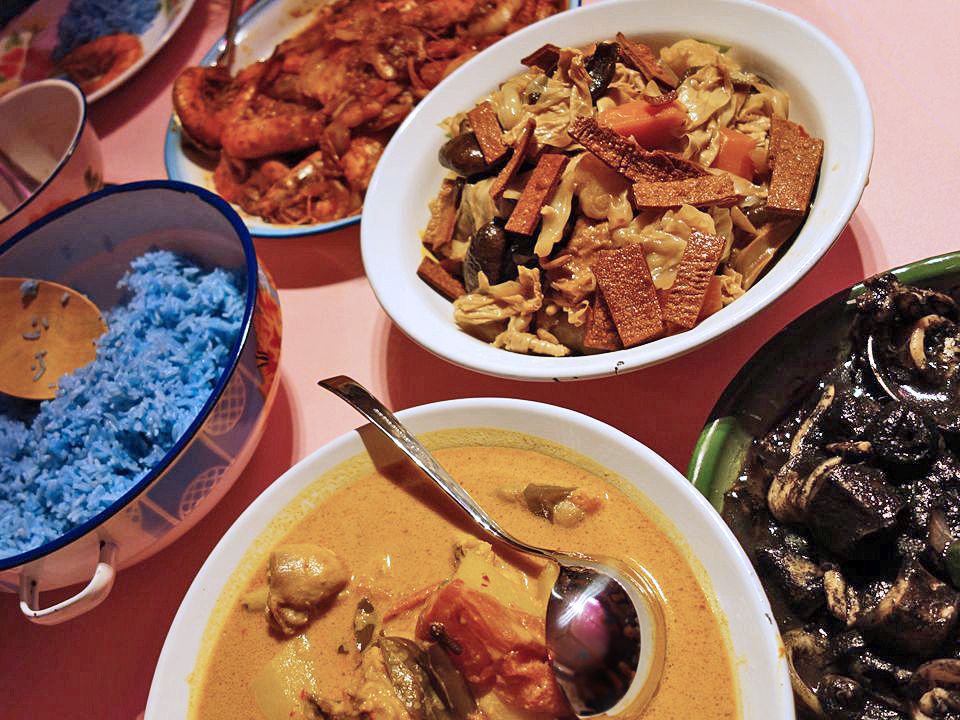
Part of a much larger meal at the private dining of PasirPanjangBoy. File photo: Claire Wee for SOTD
On the 8 Days Eat IG reel, the ebullient hawker said, “my day job is actually a makeup artist”, his mop-top amusing as his voice was cajoling. While he is known in the world of makeup, Tinoq Russell Goh made more of a name for himself as a cook. Wider fame came in 2018, when he opened his private dining business PasirPanjangBoy in his three-room HDB flat. However, there appears to be some lack of clarity with regards to the genesis of PasirPanjangBoy. Initially, it was known as Tinoq Private Dining. In 2019, before the COVID 19 pandemic struck, TRG, together with his cooking and life partner, hairstylist Dylan Chan Ling Zhang (曾凌彰 or Zeng Lingzhang), promoted their enterprise as 1 Catty n A Pinch. By most accounts, PasirPanjangBoy private dining is still operating. After the Hong Kong restaurant Bibi & Baba opened, the typical waiting time when diners joined the queue was two hours. To makan at his home here, there is apparently “a waitlist of two years”.
His F&B business was registered as PasirPanjangBoy Pte Ltd in 2019, about a year after he opened his home to anyone willing to eat in his florid living-cum-dining room. Hitherto, everyone knows the founder of PPB as Tinoq Russell Goh. So do those in the beauty industry. But, on his passport, the very different Ram Shankar appears. The few who know him “from way back” remember such a moniker too, but call him by the uncommon Tinoq. It is not clear if TRG is an alias, a professional pseudonym, or a legal change of name. Although he has publicly said that he is a “Chindian” and that his father is Indian, he does not, curiously, use a distinctly Indian surname. Or, as it appears, his father’s ( he has revealed that his dad is Damodat Balakram.) Rather, he has adopted his mother’s—Goh (named Hong Kee).
After the Hong Kong restaurant Bibi & Baba opened, the typical waiting time when diners joined the queue was two hours. To makan at his home here, there is apparently “a wait list of two years”
Some editorials in the Chinese media have identified Mr Shankar (we shall refer to him by his given name from here) in Chinese as 吴天诺 (or Wu Tiannuo); many prefer using his popular moniker in English. It is likely that his mother is a Hokkien Chinese (as most Gohs in Singapore are). In Hokkien, tiannuo would read as tilok and in Hakka, tinog, which could account for his unusual first name. Interestingly, in the production credits for the 2022 stage performance, 山的避风面 (Windward Side of the Mountain), Mr Shankar, who was the show’s makeup artist (and partner Mr Chan, the hairdresser), was listed as 吴天龙 (Wu Tianlong). We do not know if it was a typographical error. Or, just another name. In the English credits, he remained as Tinoq Russell Goh.
It is not known why Mr Shankar has given himself a “professional name”, as one makeup artist described it. Or why a middle name is necessary. Russell is a surname-turned-first-name, from the French russel, which referred to hair that was “red-coloured”. Could Mr Shankar’s once violently pink hair (that was so intense that it was almost red) point to his middle name? Another makeup artist speculated that, perhaps, the three-word TRG was easier to score jobs. Interestingly, we noted that Mr Shankar has a preference for two-two-one syllable patterns in his naming preference. Both his chosen personal moniker and business name share the similar syllable division. Admittedly, there is, when uttered, a rhythmic ring to both.
Born in 1964 to Indian father Damodat Balakram and Chinese mother Goh Hong Kee, Mr Shankar is the youngest of eight children. The family lived in one of the several kampungs in Pasir Panjang, an area that now barely hints at its rural past. Although it still goes by the old Malay name (which means ‘long sand’ but is said to refer to ‘long beach’), Pasir Panjang’s old coastline has been redrawn by reclamation. The rumah (house) attap (or, possibly, corrugated zinc roof) and its surroundings was somewhere on Alexandra Lane, now the Mapletree Business City and a stone’s throw from Hort Park. According to a 2022 Options magazine profile of TRG, it was here where “life was all about tending to the garden, rearing farm animals and eating.” It was, as it could be understood, a laid-back, uncomplicated existence.
There is no mention of what his father did to raise such a big family. His mother was sometimes described as a home-maker, sometimes, a canteen operator (who reportedly worked in Gillman Barracks). Mr Shankar told the Hong Kong press at the height of Bibi &Baba’s popularity: “My mother had a canteen, so all of us had to wake up early in the morning.” Presumably, to help with the preparation of the food to be sold. Of his earliest cooking memory, he said, “when I was nine years old, I remember making sweet-potato donuts—kuih keria, mashing up steamed potatoes and mixing them with flour. We shaped the donut, fried it, then dusted it with powdered sugar after.” But he did not say how, at age nine, he managed, if at all, to light the arang (charcoal) in the clay anglo (stove), typically found in kampung homes.
“When I was nine years old, I remember making sweet-potato donuts— kuih keria”, but he did not say how, at age nine, he managed, if at all, to light the arang (charcoal) in the clay anglo (stove), typically found in kampung homes
In his frequent recollections of his village, Mr Shankar had mentioned that his family home was behind Starlight Cinema—a humble, open-air “kampung theatre” that some grandparents who had lived in the west coast still remember going to in the late ’60s to watch the old Pontianak movies. One old-timer even described it as “rat-infested”, adding “outside food was not banned then”. Price of a ticket was between 10 to 15 cents. Starlight Cinema was flanked by hawker stalls, just as getais were back then. Mr Shankar is wont to recall that many of his neighbours were food vendors whose small businesses were near the cinema. Reportedly, when he came home from school, these neighbours would ask if he had eaten. And he joked that if he did not offer a reply, they would “force-feed” him. He frequently painted a picture of how, through food, infectious village camaraderie was formed.
Kampung life might have been appreciable simplicity, constant cooking, and endless game-play (hantam bola?) with other kids, but Mr Shankar did not always have it easy. In a revealing interview that he gave to the webpage The Best of You, Mr Shankar said: “Being a mixed race child in the ’60s was tough. It also didn’t help that I would rather play with dolls than guns. I didn’t play soccer with the boys in the kampung either.” There was cruelty on the playground too. In one recall, he spoke of terrible torture: “One day a group of kids got a string of firecrackers and they wrapped it around me and decided it was okay to light it up.” There was no rescue—not from the family, not from the villagers, not from the hawker-neighbours who loved to feed him. “Nobody stood up for me,” he said. “And no one defended me.”
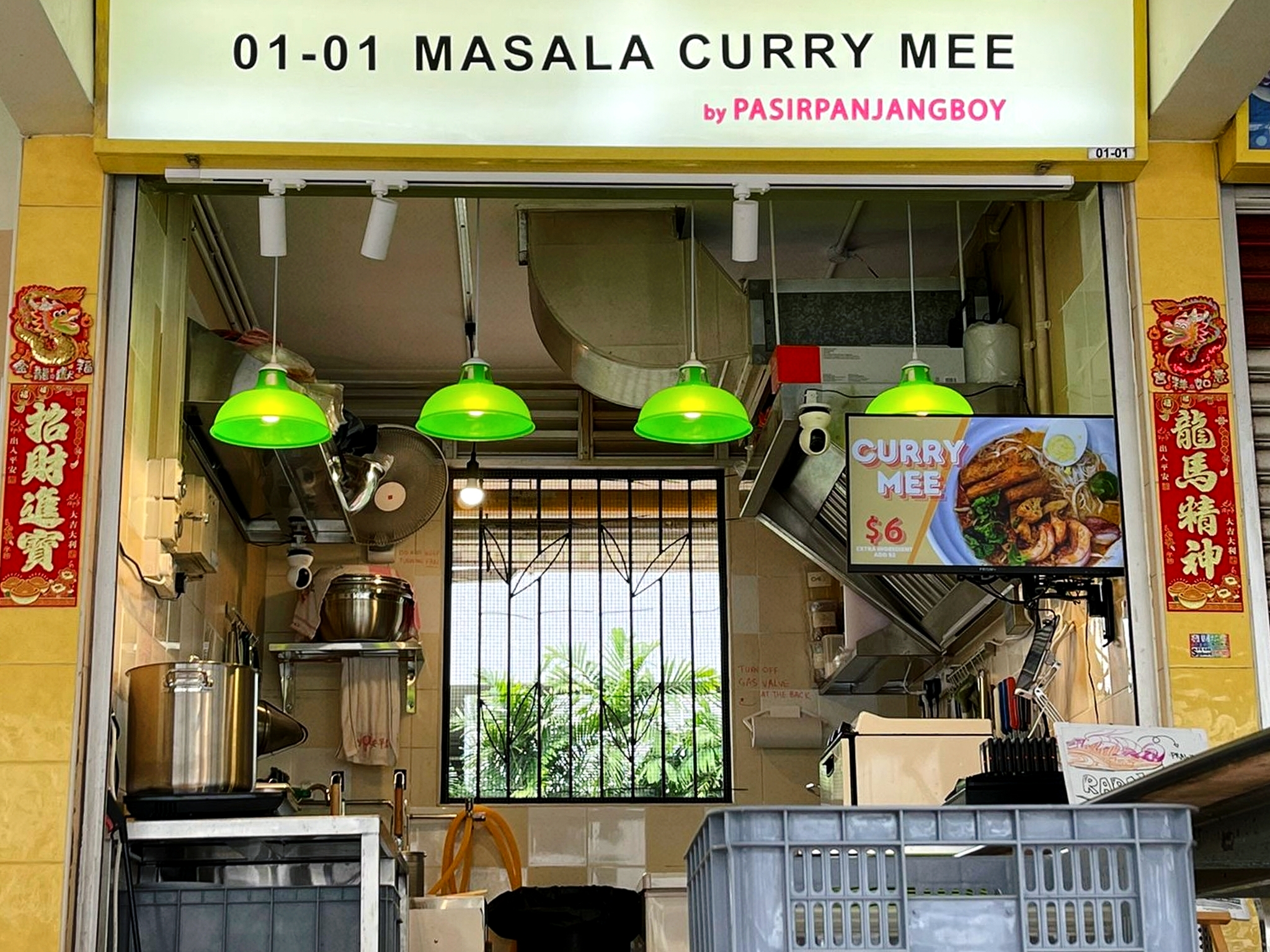
Pasir Panjang Boy’s new stall at Havelock Road Cooked Food Centre. Photo: Kar Ho Ko for SOTD
While the general impression that has been given about his family was that the parents and their brood were a happy lot, he did also say in The Best of You: “Being the youngest, I felt that my mother never had time for me and I was left to be looked after by other people.” His carers included his paternal grandparents and his “godmother” Shirley Tay, the cooking doyenne behind restaurant The Peranakan. But at home, sibling discord was evident. “My sister who is the seventh in the family would call me names whenever she saw me playing with my dolls and it didn’t help that she was the darling of the family.” His misery was compounded by the chores he had to perform and what today would be considered child abuse. “I had to do the laundry and prepare dinner straight after school, ” he said. “But I grew so tired of being whacked, slapped, made fun of, and not having anyone fend for me.”
He claimed that it was his grandparents who helped him find peace and “to love again”, as Diana Ross sang in 1981. Consequently, he became closer to his mother, especially after “she accepted my alternative lifestyle.” (He did not say why his lifestyle was “alternative”.) There is, subsequently, no mention of his father, the name-calling sister, or other siblings. It is not clear if he keeps in touch with them. Or if he has forgiven those who did him wrong in the past. He did say: “I choose not to allow these incidents from my past taint my perception of the world and its people.” Yet, at the same time, he does not look to his immediate family for anything. “I don’t believe that blood is thicker than water,” he emphasised. “My friends have been my family; my partners. My good friends have been there for me, not my kin, but the friends around me who have been my pillars.”
His misery was compounded by the chores he had to perform and what today would be considered child abuse
School was no respite from domestic stress. Mr Shankar went to the neighbourhood Batu Berlayar School (whose name, meaning ‘sailing rock’ in Malay, was derived from the rocks at Dragon’s Teeth Gate [龙牙门 or longyamen]). As he recounted to The Best of You, “I was made fun of and bullied by my peers and teachers.” That members of the teaching staff were guilty of intimidating behaviour is disturbing. It is more unsettling when he said that he is “dyslexic” (although he did confirm if he was clinically diagnosed). He elaborated: “For me, to learn something then, I had to learn it 30 to 40 times. They were neither kind nor patient with me.” It is not known if he completed his education at the school. In 1982, when Mr Shankar was serving his national service, Batu Berlayar School closed due to unsustainable enrollment numbers.
His accounts of growing up in a kampung are likely authentic, but some people who have worked with him wondered if he has, in fact, romanticised his young life. Personal stories can, of course, be self-fashioning. But, while his narrative would interest MediaCorp scriptwriters, it is improbable—unlike many in fashion with inexplicable pretentions to a colourful past—that he embellished it. Things seemed to turn for the better when he became a makeup artist, and were further improved when he met the far less brash Dylan Chan in 2007. Together, they cooked up a storm and created, in their own home, a caricature of what kampung dining could be. Ram Shankar told Options magazine: “Makeup fuels my creativity, but cooking feeds my soul.” With PasirPanjangBoy’s not-waning popularity, it seems his soul remains well-fed.
Illustrations: Just So
 Style on the Dot