As it turned out, a goodbye is a look-back. Is #SGFASHIONNOW so spectacular that it merits a revisit?

By Raiment Young
The compact showcase of what contemporary Singaporean fashion is returns to the Asian Civilisations Museum (ACM) this month after last year’s absence. Initiated by the museum’s out-going director, Kennie Ting, #SGFASHIONNOW “explores Singapore fashion through the lens of our multicultural, cosmopolitan port city heritage”, their marketing material states. This is the final installation of #SGFASHIONNOW, suggesting that in-coming director Clement Oon has no plans to extend the three-parter. The current show is essentially past exhibitions, revisited. This travelled to South Korea last year as #SGFASHIONNOW: Runway Singapore, a curious description considering that most of the clothes in the exhibition had not been seen on a runway prior. However immodest the titular declaration sounds, the “third and final edition” is still no blockbuster, even with the new #SGJEWELLERYNOW tagged on.
The familiarity did not escape me. It is essentially the debut and sophomore #SGFASHIONNOW coming together as one. Both exhibitions I remember clearly. To make the latest more substantial (or, as touted, the largest in the “series”), newer pieces deemed fetching today or adequately multicultural were thrown in so as to achieve the braggable total of “28 established and emerging designers” of the show (emerging is not necessarily synonymous with skill or creativity). As in the past, the gestalt #SGFASHIONNOW is situated at the very rear of the museum, in a relatively small Contemporary Gallery. Twenty eight exhibits do not need a space larger than this, which, sadly, also says that I could discover Singaporean fashion at a glance. Still, this is a far cry from 2021’s eight dresses or 2022’s sixteen looks. Concomitant #SGJEWELLERYNOW is curiously not an accompanying exhibition by proximity. “Staged as an intervention in the museum’s Jewellery Gallery”, according to ACM, it is sited on level three’s Materials and Design zone.
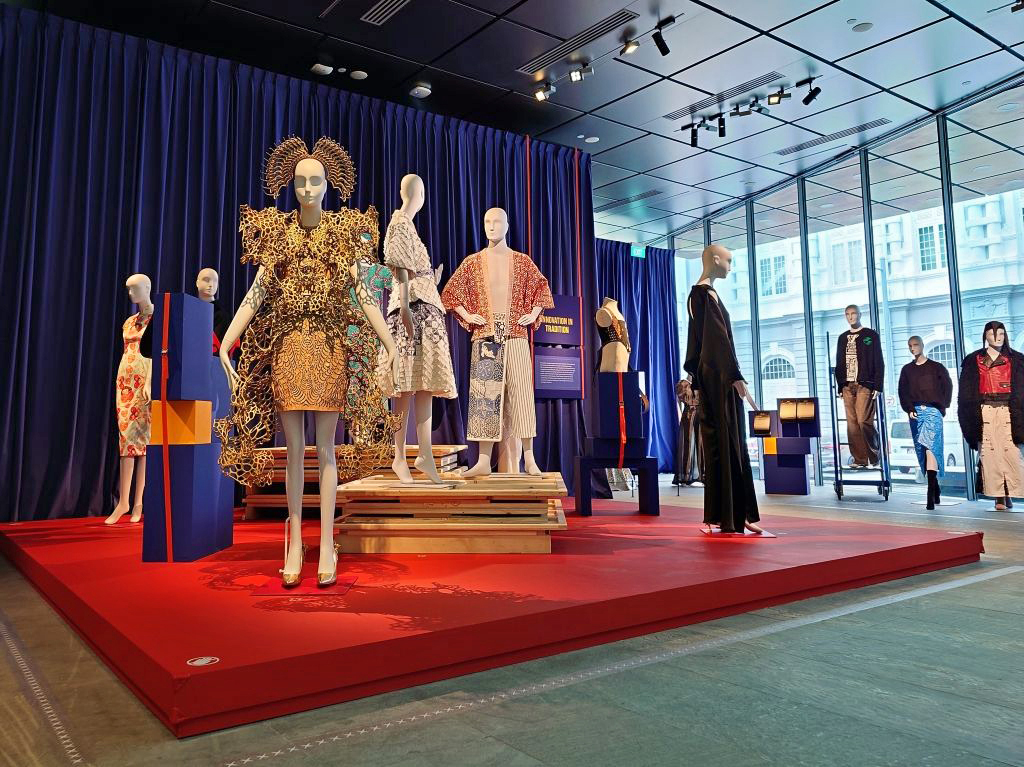
The main exhibition area at #SGFASHIONNOW
The exhibition opened last night with an impassioned speech by Kennie Ting. In a very long address, which some attendees described to me as “excruciating” and “unbearable” (someone even asked me, “do you have Panadol?”), Mr Ting went at length about his performance at ACM—“an amazing eight-year journey”—to an audience that was indifferent, but polite enough to clap when encouraged by Mr Ting, himself an enthusiastic, nodding clapper. He waxed about his tenure and how wonderful it had been for him without saying why the self-satisfaction would matter to those watching him enthused. There was the curious need to justify his decision in giving space in the museum to support Singaporean fashion, despite, as he described it, facing the skeptics who did not believe it was tenable. This was Mr Ting, in a rust-coloured suit, at his most sibilant and animated, as he trumped with political fervour his achievements, as well as thank, rather profusely, those who supported him.
In singing the praises of local talents, Mr Ting seemed to have painted himself as the fashion impresario that we never had, a saviour to be canonised. On “the creativity you have in Asia and in Singapore,” he said passionately, “the cup runneth over”. How so, he did not elaborate. (Later, on Facebook, his admirable enthusiasm was not diminished as he wrote—again with references to spills—about the “overflowing abundance of creative talents we have in Singapore fashion…”) Then he came to the question I have been waiting for: “What is Singapore fashion?” I was really happy he asked, but, unfortunately, as he lamented, “we don’t find the answer,” smoothly dismissing it as a matter for investigation. “Instead,” he added, “we suggest that it is cross-cultural diversity…” ACM curator Jackie Yong, Mr Ting’s sidekick, was just as non-committal when she told The Straits Times in a report of the last #SGFASHIONNOW: “We don’t try to define what Singapore fashion is. In a way, you can see how an institutional point of view meets a student-led view—what they think a museum should be collecting in terms of emerging design.”

From the ‘Craftsmanship’ segment ot the exhibition. From left: Laichan, Time Taken to Make a Dress, Ong Shunmugam, Andrew Gn and (far right) Stylemart

Also from ‘Craftsmanship’ (from left): Andrew Gn, Stylemart, and Maison Thomas Wee

And the final two (from left): Benny Ong and Ashley Isham
Fashion students these days are really lucky; their views are valued and “what they think a museum should be collecting in terms of emerging design” would be considered, even if no scholarship is involved, in the final choice of exhibits displaying recent Singaporean fashion. I am not sure how much say they have, but based on some curious choices, they were probably rather persuasive. This is a rather good indication of what the prevalent taste in fashion on our island is. Or what the (very?) young consider culturally relevant, even if the choices made are likely based on commercial preference than those that could be potential historical artifacts. As with before, the students of Lasalle College of the Arts’ School of Fashion were co-curators of #SGFASHIONNOW, except that this (last) time, they only needed to add the extra names they wished to see to build on the old base. Or even the specific designs of those names they love and, therefore, deserve museum space. Unsurprisingly, more street-centric choices were made.
There are 13 additions (including, oddly, one single footwear designer, Pek Shun Ping of Aliveform), but it isn’t clear if all of them were suggested by the students since it is unlikely they would pick Benny Ong, a blast from the past that is way before their time. Some brands or designers were previous participants, such as Baëlf Design (2021), Harry Halim (2022), and Lina Osman of Linaoth (2022), but they presented garments that were not those submitted to the previous two exhibitions. And some of the new (or newish) brands could be just fillers to meet the lucky number 28, such as the startlingly lame Esh by Esther or the distinctively African OliveAnkara. When you add some, you may have to subtract, too: brothers Chong Keng How and Chong Kange’s Biro from the second edition is omitted, so is Central Saint Martins alum Brian Yeo. It is not known why their works are not represented. If the final line-up is to show the breadth of Singaporean fashion today, what awe-arousing Singapore Stories, to borrow from the annual competition, were told?
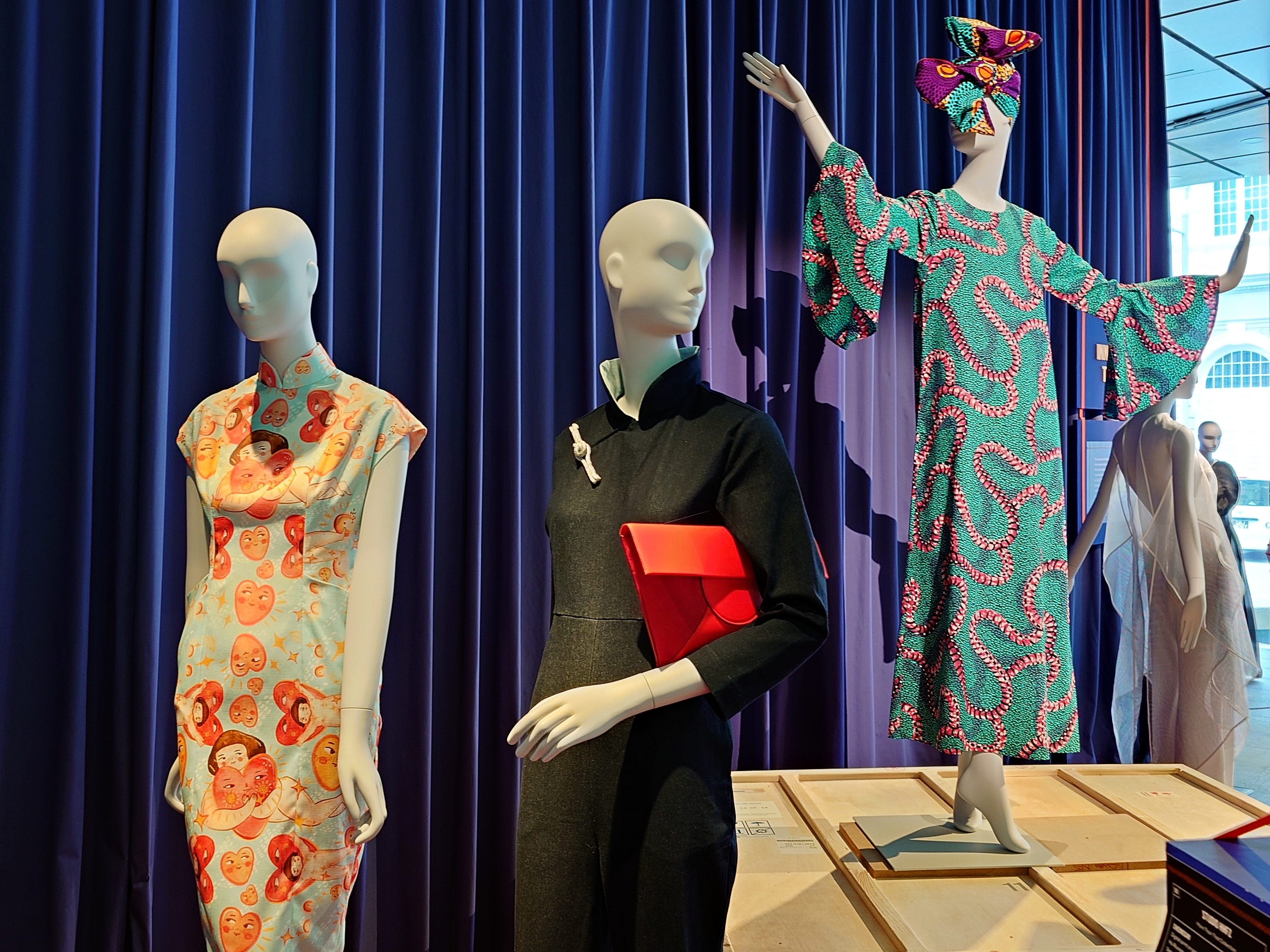
‘Innovation in Tradition’: (from left) Studio HHFZ, Nude Femme, and OliveAnkara
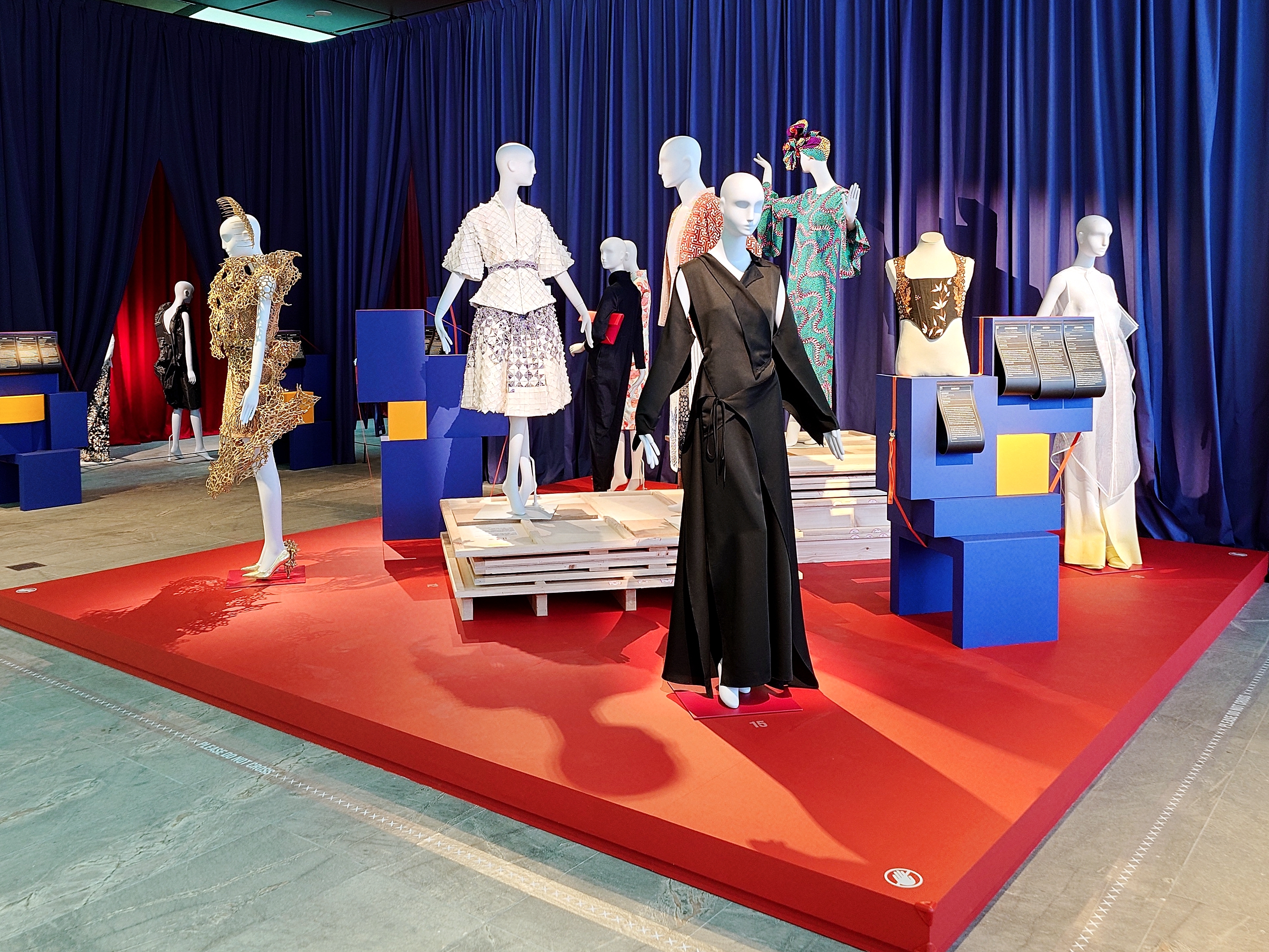
More ‘Innovation in Tradition’: (from left) Baëlf Design, ANS.EIN, Baju by Oniatta (partially hidden), Max Tan, Putri Adif (corset), and Jon Max Goh
The exhibition is divided into three parts/areas: Craftsmanship, Innovation in Tradition, and Urbanite, as if they should be distinct from each other. Do they utter to me, for example, that a designer who takes pride in his/her craftsmanship is incapable of Innovation in Tradition? Priscilla Shunmugam of Ong Shunmugam would be the first to refute that! Goh Lai Chan, holding her hand, would too! Or does it also say that those who are distinguished by Innovation in Tradition cannot boast of Craftsmanship? Max Tan would be livid! Those with Craftsmanship are not Urbanites? Tell that to Andrew Gn! Or that an Urbanite would not be able to offer Craftsmanship? Let Esther Choy of Esh by Esther counter that! Although I have seen most of the clothes (and have posted about the past two installations of #SGFASHIONNOW), it was still eye-opening for me to see them, as well as the shortcomings again up-close. Thematic differentiation do not minimise the technical and qualitative deficiencies, even for the second time. An Urbanite placing does not absolve you from deplorable workmanship.
The show is an attempt, as far as I understand it, to determine what Singaporean fashion is at the moment. Yet, there is the curious addition of Benny Ong in the exhibition described by the very present and assertive now. Mr Ong, who no longer designs, is a textile artist since the early 2000s. He made a name for himself in London much earlier, in the ’80s (his eponymous label was founded in 1976), way before Ashely Isham stepped on English soil for the first time (but they are paired, and just the two of them—presumably as ‘London designers’). Mr Ong’s sub-labels Number 2 (later renamed Benny Ong International) and Sunday were produced by two renowned Singaporean companies of the time, Mido Textiles (that owned the now-defunct China Silk House) and Majestic Industries (that was behind the once popular Bibi & Baba label, now a producer and retailer of school uniforms) respectively. The yellow silk dress with the rosette shoulders, ruched bodice and gathered skirt featured in exhibition is, I believe, part of a 40-piece lot that he donated to the National Museum of Singapore in 2006. While Mr Ong, now 75, no doubt has a major part in the history of Singaporean fashion, his work is not quite the empathetic now that ACM seeks to underscore.
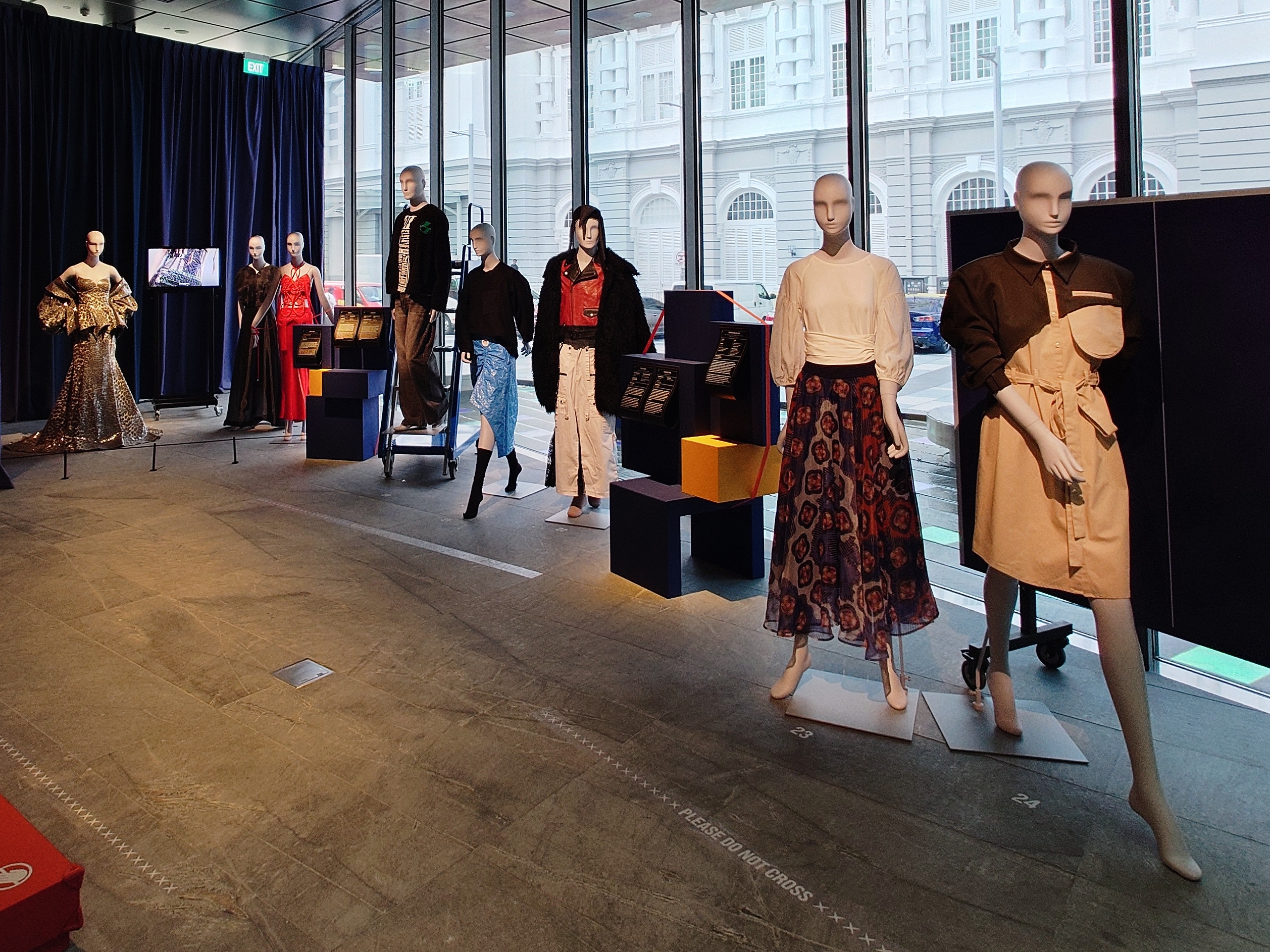
Considered ‘Urbanite’ are: (from right) Esh by Esther, Reckless Erica, Youths in Balaclava, Studio Vetyver, The Salvages, Shawna Wu, Linaoth, and Harry Halim

The exhibition’s sole name for footwear, Aliveform

Two other ‘Urbanites’: (from left) Labal and Stolen
A friend of mine, who saw ACM’s Instagram post on the exhibition, texted me: “What’s surprising is that none of them (based on what’s featured here) have any connection to the idea of 2024.” I agree. Walking into #SGFASHIONNOW is like entering a pop-up time capsule, with the now-closed Megafash vibe, or a cultural show. Yet, I feel that the clothes need not articulate global 2024, but could at least say something about extant aesthetics or something that could point forward. However, they do not because it is a tough call. In an FB post last August about #SGFASHIONNOW in South Korea, Kennie Tng wrote: the exhibition “suggests that there is no one answer to WHAT IS SG FASHION (yes, in full caps), beyond that it reflects our cosmopolitan cross-cultural, old+new, highly urbanised, port city heritage/essence and is thus constantly evolving and full of energy/dynamism!” It is rather obvious, after catching one’s breath, why, collectively, SG fashion cannot point to a recognisable whole, the way Japanese fashion is identifiably unconventional and is often committed to the radical while respecting the fundamentals of dressmaking.
ACM has always liked to pose aloft the port-city standpoint (at least under Mr Ting’s watch). SG fashion designers, therefore, need not be locally born. As long as you register a business here, you are a Singaporean brand and you would receive support from Singapore Fashion Council, which may explain why #SGFASHIONNOW first-timer OliveAnkara, conceived by Nigerian-Italian Ifeoma Ubby, is in the exhibition. Ms Ubby has put up a good business of making clothes (sometimes Southeast Asian ethnic styles) with the riotously patterned African fabric ankara. “The meaning of each print has its own story,” Ms Ubby elucidated in an accompanying video, but, to borrow from the competition again, is it a Singapore Story? Or is that the cosmopolitan component that ACM touts? A port-city feature? I should not be so quick to question. Even our own designers cannot offer a compelling narrative.
The inclusion of a section for Urbanites, as ACM states, “demonstrates the variety and vibrancy of styles inspired by urban environments.” By that, I assume it refers to our urban environment. Yet, the streetwear labels represented—The Salvages, Studio Vetyver, Youths in Balaclava, and Labal—show clothes that only Kanye West devotees would wear in our 30+°C weather. How is that saying something about us and our fashion choices? Or, the poorly-proportioned and lamentably-made separates of Esh by Esther? Designer Esther Choy, a Lasalle College of the Arts alum said, through the accompanying video intro, that the pocket bag is the feature of the shirt-dress she made, yet the exposed pocket bag inexplicably does not enjoy the benefit of tidy stitching, finishing and pressing. Did Ms Choy realised this was a museum, not a Lucky Plaza window? Kenny Ting’s adamance in the existence of Singaporean fashion is admirable, but he does not explain why Singaporean fashion, in his view, is exceptional. Perhaps, rather than ask what Singaporean fashion is, which, to me, is presently a misnomer, we should be asking how good Singaporean designers are.
#SGFASHIONNOW runs from today till 1 September 2024. Admission is free. Photos: Galerie Gombak
 Style on the Dot