Behati has created their bulkiest, most bizarre baju yet
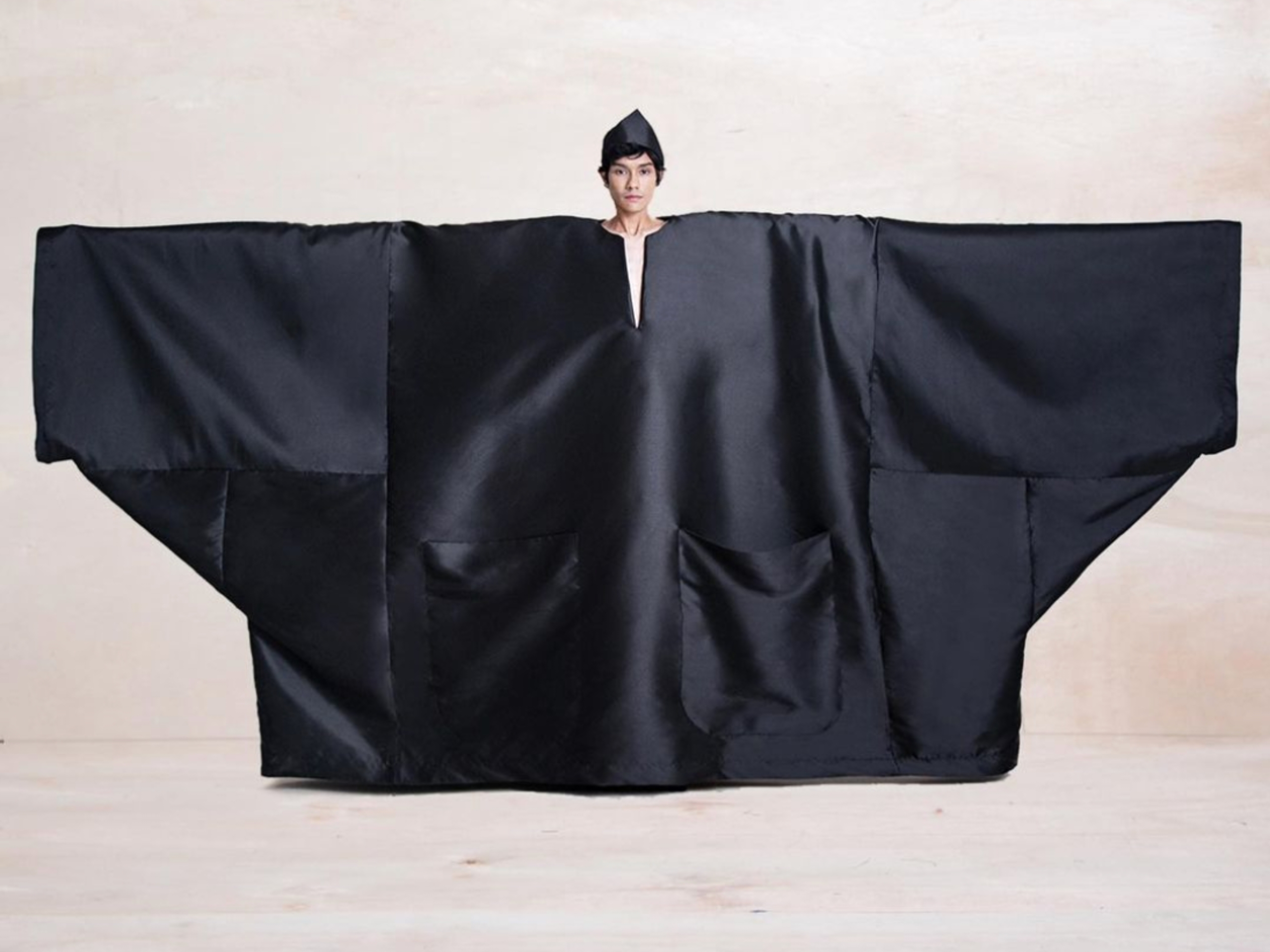
Is big really better? We found ourselves asking this existential question when we saw the above photo that the Malaysian label Behati just posted on their Instagram page. This was an upsized version of the traditional baju Melayu, but it was no ordinary shirt “oversaiz”. This was not just big, such as a baggy sweatshirt; this was enormous, as wide as a rumah kampung (village house) or cadar (bedsheet) stretched on a clothesline. How big can a garment get without being ridiculous? Or gila (crazy)? Or laughable? Behati seemed to have the answer. Their latest creation, described by the brand as “baju Melayu terbesar (the biggest Malay shirt)”, was to be worn, not, as you might suspect, hung on a wall. Or purposed as a tent, even if it looked like one. It was a statement-making attire, an expanse of baju, blacker than the blackboard, and broader than a tikar (mat), which, incidentally, had been used by Behati as outerwear. Or, a stole. Seriously.
The baju Melayu is, of course, traditionally a loose-fitting garment. It is appreciated for its relaxed silhouette, but not capacious excess. Clearly, the essence of unrestricted comfort. It is, therefore, not worn tight, although the skinny fit has been adopted, such as those seen in last year’s music video of the festive song Chu Ku Chuk Raya by “cosmetic mogul” Aliff Syukri, who sang in what could have been a onesie akin to a leotard. Those who took it to the ketat (tight) extreme were, unsurprisingly, met with stern disapproval. A police report was made against the entrepreneur/singer, according to local media at the time. Veteran television host and actor Jaafa Oon—without naming anyone—posted on Facebook and censured the liberties taken to modernise traditional Malay wear. He wrote: “Kalau kita tidak hormat pakaian warisan kita, siapa lagi (if we do not respect our dress heritage, who will)?”
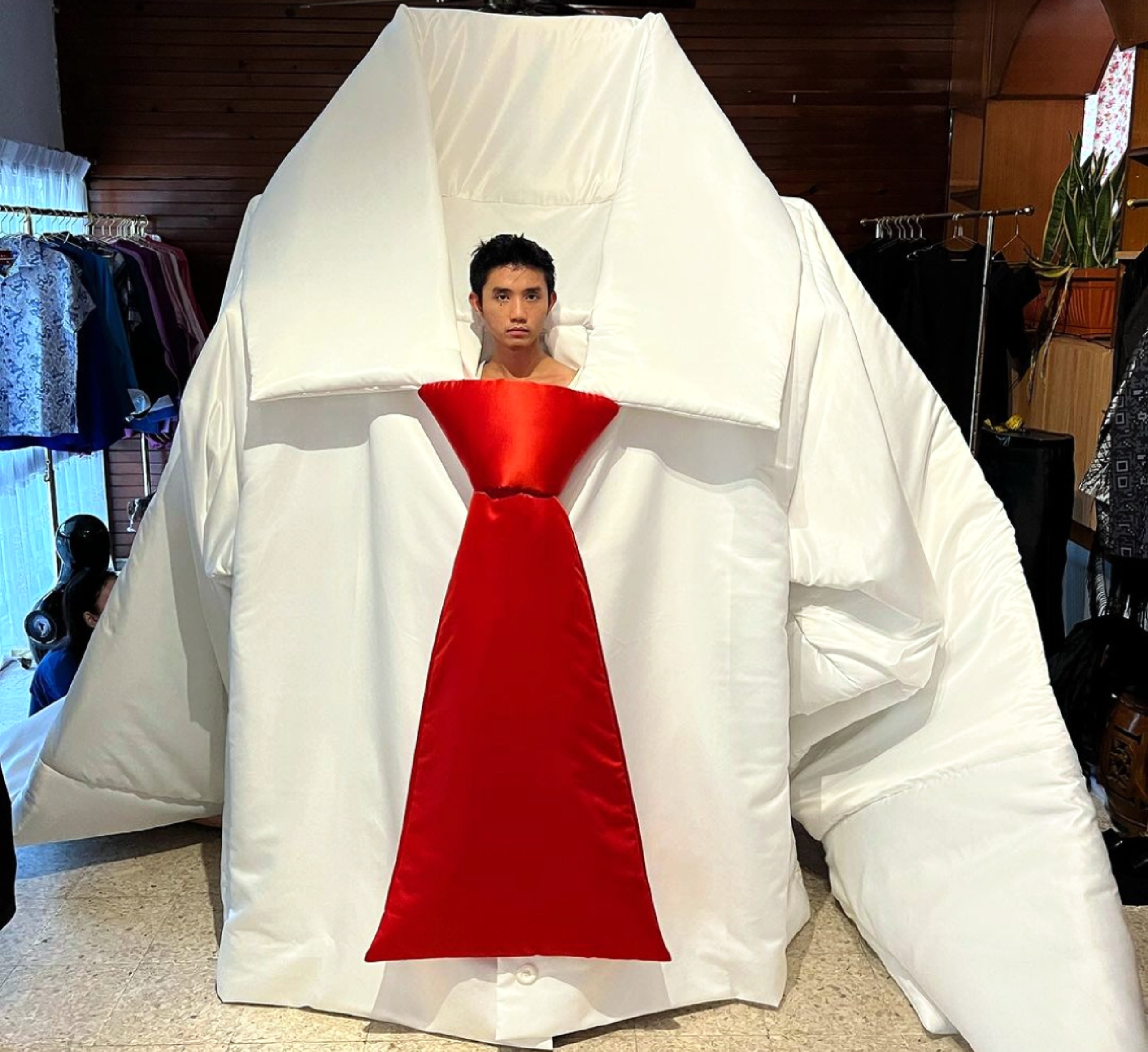
Tan Kel Wen was his own fit model for his giant of a shirt, seen at the last Kuala Lumpur Fashion Week
Perhaps Behati? The brand’s designer-founder Tan Kel Wen considers himself to be a “pahlawan (warrior) realness”. Did he mean, as with many designers of his generation, authenticity? And, which is borne out by the massive shirt he put out, presumably to sell? However real Mr Tan touts himself to be, one can’t help but sense that he was trying to out-distend Balenciaga’s Demna Gvasalia (admittedly they are from different leagues) who has yet put a limit to how enlarged some of his clothes have become (such as this blazer). Mr Tan thinks he can be even more unrestrained in his pursuit of reimagining ethnic wear (not just the baju Melayu). As he has said before, he promotes—and espouses—“busana Melayu (Malay fashion)”, now available for fans here to view at Design Orchard. It is not clear if that meant a just-as-passionate embrace of pakaian warisan.
This was not the first time Mr Tan showed clothes that would not be out of place in the wardrobe of the gergasi (a giant in Malay folklore). Last year, at Kuala Lumpur fashion week, he presented a massive shirt—complete with a limp red tie Donald Trump would love to death—that was originally meant to be for his Next in Vogue show. On IG, he described his ungainly and unwearable piece as “fashion that is designed for attention.” Tan Kel Wen’s garments undeniably have more to do with how they would look on media that is moden, such as Instagram, than advancing the mastery or inventiveness of dressmaking. Or is the enormous shirt a visual metaphor for how big Behati has purportedly become, and how “untouchable”?
Photo: behati/Instagram and kel_wen/Instagram
 Style on the Dot