The Belgian designer has announced that he shall not serve as the creative director of his eponymous label after the next PFW show
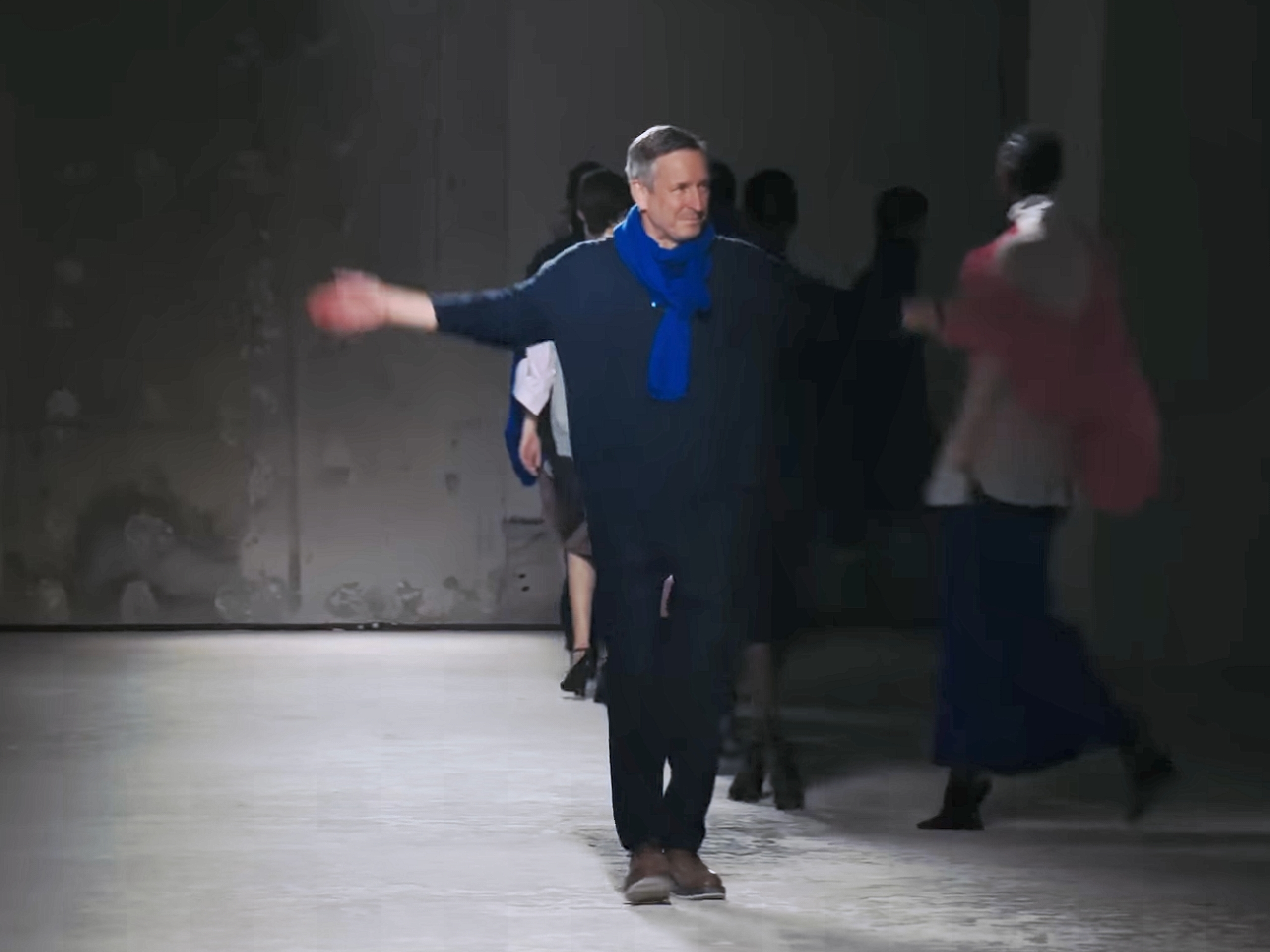
Dries Van Noten taking a bow at the recent autumn/winter 2024 show in Paris. Screen grab: driesvannoten/YouTube
After 38 years behind the label he co-founded, Dries Van Noten announced on Instagram hours earlier that he will “step down at the end of June (after the men’s spring/summer 2025 show during Paris Fashion Week)”. It was a reveal that took the fashion world by surprise and many, including journalists such as Washington Post’s Robin Givhan, responded on social media with a simple “I’m in mourning”. The 65-year-old continued in his IG message, “now, I want to shift my focus to all the things I never had time for.” The news of Mr Van Noten’s impending stepping-down comes barely three months after Andrew Gn announced that he was bidding au revoir. But the Belgium designer did not bow out after a flashy retrospective in his homeland. While Mr Gn did say that he’d like to “spend the following years continuing to build the Andrew Gn legacy”, he did not say the brand would continue with another designer. Conversely, Mr Van Noten stated: “I feel it’s time to leave the room for a new generation of talents to bring their vision to the brand.”
Mr Van Noten came to prominence when he was a part of the group emerging from Belgium in the early ’80s known as the “Antwerp Six”. The sextet included Dirk Bikkembergs (born in Germany), Ann Demeulemeester, Walter Van Beirendonck, Dirk Van Saene, and Marina Yee. All of them graduated from The Royal Academy of Fine Arts in Antwerp (also compatriot Martin Margiela’s alma mater) and was trained under the legendary designer/lecturer Linda Loppa, a fellow Belgian who was a pioneer in her native city not just for the rigours and inspirations she brought to the famed arts academy as the director of its fashion department (in 2007, former student Mr Van Beirendonck took over the role), but also as a bold retailer who sold less commercial names at the time, such as Jean Paul Gaultier, Helmut Lang, and Comme des Garcons, through her womenswear store Loppa.

Accompanying his IG message is a portrait of Dries Van Noten and his pet Airedale terrier Harry. Image: driesvannoten/Instagram
In 1986, shortly after the six school mates graduated, they grouped and went to London to participate in the British Designer Show. As the story went, the group’s exhibits were not well situated (on the topmost floor of the location) and buyers apparently did not desire to go that far up. Realising that they needed to do something to improve the foot fall, they decided to print some flyers and have them distributed in the vicinity. A buyer from the famed New York store Barneys was curious enough to venture upstairs and was thrilled to find the work and voices of very different individuals that were singular in how uncommon their visions were. He placed the first order. When the media later learned of the group and were unable to pronounce their names, they were simply referred to as the “Antwerp Six”.
Dries (pronounced Drees) Van Noten first offered menswear and debuted in Paris Fashion Week in 1991. This may explain why he has chosen the men’s spring/summer 2025 season for his final collection. Barneys, in the early years, was reportedly so impressed with his designs, they bought the smallest sizes to sell to their female customers. Two years after his Paris debut, Mr Van Noten showed his first womenswear line. He has since presented only four collections a year, unlike other major designers who are compelled to include the pre-seasons and other special capsules. Perhaps because of this self-imposed restriction, Mr Van Noten was able to consistently create the dreamy and luxe clothes that, while clearly wearable, were not unchallenging to the imagination or the desire to possess and keep them. Admired for his independence, he has not wavered, surviving the ’90s, when minimalism emerged and held sway—causing his aesthetics to lose favour—to come back stronger in the mid-’00s (regrettably, his freestanding store at the Shopping Gallery of the former Hilton Hotel closed several years back), culminating in the spectacular collaboration with Christian Lacroix in spring/summer 2020.

Dries Van Noten spring/summer 1997. Photo: firstVIEW
In his body of work, three components pulse discernibly: colour, texture, and pattern. His design in the early years might have been straightforward, but his chromatic sense and his pairing of prints were not. One of our favourite collections was from the season of spring/summer 1997. The show started with an all-black palette, but soon revealed colours and in combination that one tended to see in Southeast Asia, especially in the silhouettes with the leanness (but not constriction) of the kebaya, the linear skirts that were as relaxed as the sarong, and the decorative work on the fabrics that recall the needlework of couching of the East Indies. Post-2000s, Mr Van Noten has not reprised the Southeast Asianness of his early years overtly, but he has never stayed away from the resplendence and elegance that are evocation of, say, old Balinese royal courts, with characters that might be considered consorts gone rogue.
We have often been asked why there has not been a designer here who could be the Dries Van Noten of this land. Not that we desire a knock-off of the Belgium designer, but that a city surrounded by some of the most recognisable silhouettes of ethnic dress isn’t able to nurture talents who are able to create clothes with intuitive Southeast Asia discernment is indeed rather curious. Not that designers here have not tried, but more often than not, the results are, at best, jokey. Unlike Mr Van Noten, the approach has been, hitherto, too literal, too laden with cultural obligations, or too compelled in envisioning a national dress. Mr Noten has no such aesthetical commitments, and the era of cultural appropriation—real or imagined—has not rumbled in. He took what he saw to be interesting, beautiful, applicable, and simply made them into ravishing, relatable, and reliable clothes. That is why his designs have a shimmering and untiring lilt about them, just like the distinctive sonance of the Balinese gamelan.
 Style on the Dot