As Ramadan begins and Hari Raya thereafter, a pop-up, Riang Ria Raya, featuring a quintet of Malaysian labels was launched last Friday to bring merriment to the city’s favourite fashion store
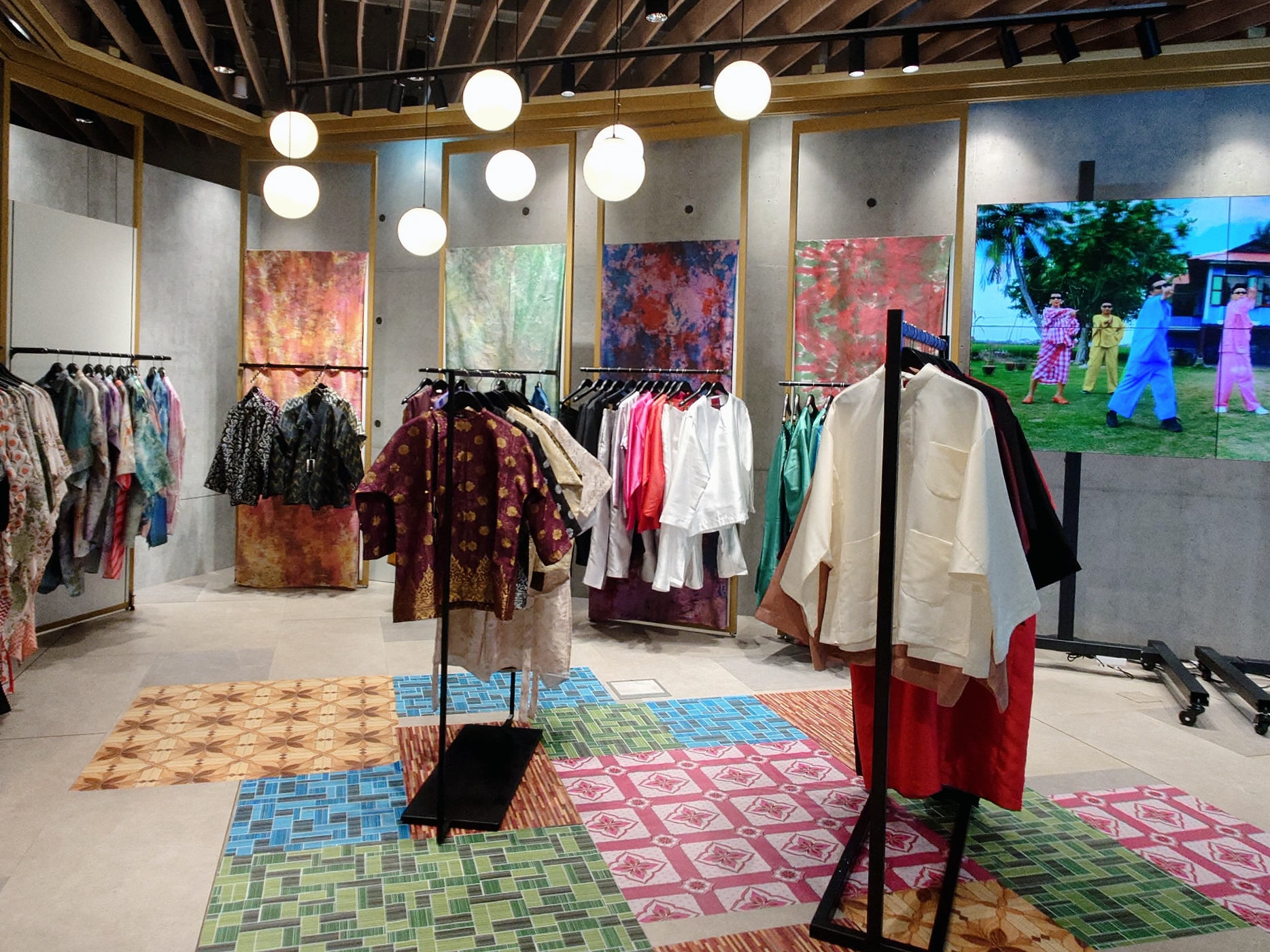
Design Orchard’s first showcase of Malaysian labels
Five years after it opened and four after it gave itself a makeover, Design Orchard aims to project a vestige of the jolly. It has set up a “pop-up” in the right corner of the store to celebrate the upcoming Hari Raya festive season, and it is adroitly alliterated as Riang Ria Raya (or Joyful Raya). Four Malaysian clothing labels are featured and they are available in the multi-label store for the first time: The viral Behati by Melaka-born/Muar-bred Tan Kel Wen (陈楷文, Chen Kaiwen), eponymous label of Kuala Lumpur-based designer Eric Choong (宗柏伸, Zong Baishen), the resort line Angelique by Penangite Tan Pei Ling (陈佩玲, Chen Peiling [transliteration]) and ethnic-wear brand Sawang by compatriot Lee Tche Fuh (李子富, Li Zifu), as well as the one non-garment label, KL’s TaleSock. This could possibly be the largest gathering of Malaysian names under one bumbung ever assembled on our tiny pulau.
Design Orchard has been active in promoting ethnic clothing (apart from the batik wear that has enjoyed considerable prominence in the store), having dedicated the same spot to Deepavali last year and the Lunar New Year last month. But, they weren’t showcases of brands from India or China, unlike their latest pop-up. This time, they wanted to go Geylang Serai and a small corner was put together to evoke a space that might have come out of a kedai kampung (village shop), and the Malaysian brands fit the konsep. While no discernible expense was lavished on the set-up (mainly on the floor—a colourful digitally-printed pastiche of what could be reimagined old linoleum mats), the racks of baju Melayu themselves were beraya enough to transmit an air of festive cheer. Panels behind four racks of clothes were hung with Eric Choong’s hand-dyed fabrics. On the two-video-screens-as-one erected to the right of the space, Behati’s enthusiastic promotional video, Pelangi (Rainbow), from last Raya—shot in a village—was played on a loop, augmenting the pop-up’s balik kampung vibe. No signage was needed to identify the space.

The Riang Ria Raya corner at Design Orchard
Riang Ria Raya, although launched on International Women’s Day, fascinatingly catered mainly to men, except Angelique’s breezy, beach-friendly kaftans and such (none quite baju Melayu) that recall the old Tangs label Island Shop. Or, Eric Choong’s massive shirts, which could be considered unisex. Interestingly, although the fashion collections were a result of curation (as Design Orchard calls it)—shorthand for “careful selection” but not necessarily so—to cater to those shopping for Hari Raya Aidilfitri, the brands picked are by Chinese designer-founders, but those with a penchant for the Malay baju. It is not immediately clear why labels such as celebrities’ favourites Rizman Ruzaini or Alia Bastamam were not courted. Our guess is that Design Orchard wants to align itself with the younger set that has strong social media presence. Or, those brands that stay on the kasual side of dressmaking. Selamat datang ke Singapura.
Malaysia has, we have often been told by those who cross the Causeway with amazing regularity, a “vibrant” local fashion scene. Young (or young-ish) labels take pleasure in the support from Malaysian stars, influencers, and retailers. Among the latter is the Collab Store, a Kuala Lumpur outfit at the Shoppes at Four Seasons Place (next to KLCC) that put together the Riang Ria Raya pop-up. The store’s founder, Richard Tsen (曾详记, Zeng Xiangji), an industry veteran, is considered to be a Malaysian-fashion impresario, and a keen supporter of Asian labels. Despite the initial favourable publicity Collab Store gained when it opened in 2021, some KL observers thought that it has lost the indie edge that the store opened with (they once stocked one of KL’s more technically-forward and promising labels Kit Woo, but it has not been seen since February, although on the srore’s website, the brand is still listed). Our KL source did not hide his dismay: “It started out trying to be ‘progressive’, with ‘modernised’ Malay wear, but they are doing more athletic wear. One section has some art/fashion books, but it is extremely pathetic as these are actually discount books sourced from a distributor.”
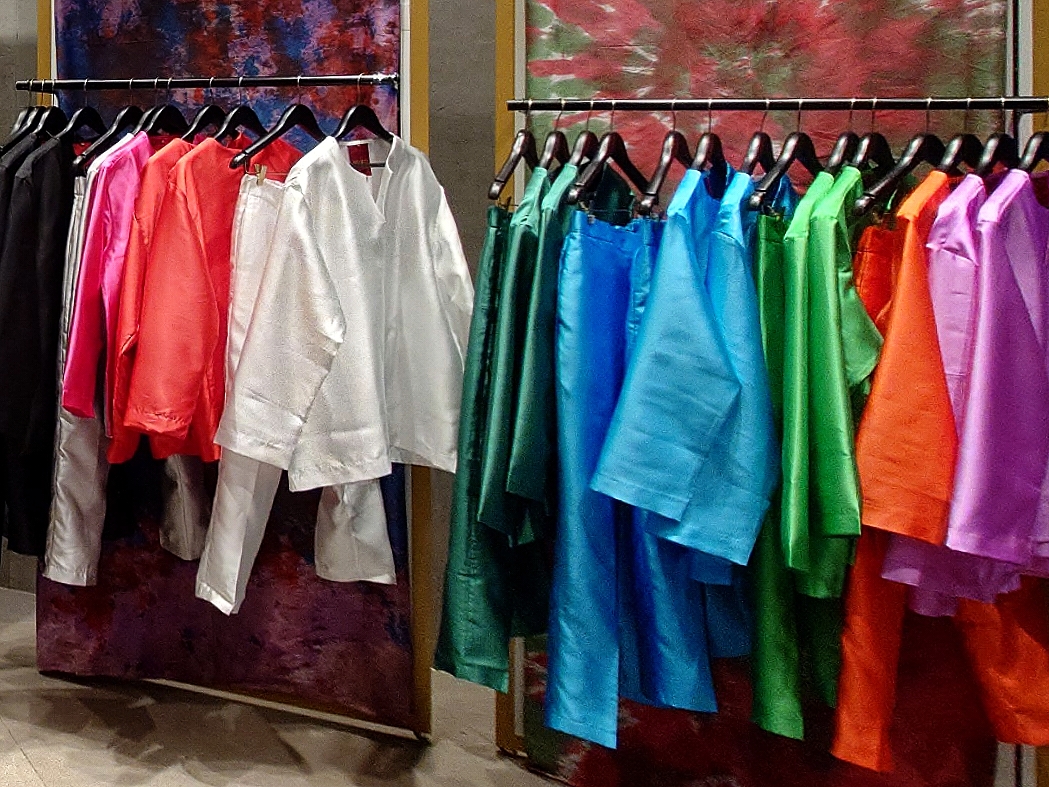
Behati’s vividly-hued baju Melayu
Mr Tsen, we were told, arranged with Design Orchard to showcase some of his prized labels, including the “untouchable”—as one veteran Malaysian designer was once overhead saying—Behati. The five-year-old brand’s latest collection was, last November, the sole highlight at the Vogue SG’s third anniversary celebration, as well as the inauguration of the magazine’s Next in Vogue program. Designer Tan Kel Wen was in attendance to show some of his self-lauded “kutior” pieces that were also seen during KL Fashion Week last year. We had thought that Behati’s retail presence here would allow not only their many Singaporean fans to buy the clothes, but to also give us the opportunity to appreciate those very pieces that have been so raved-about, up-close. Fashion, as we have always maintained, is not only about the optics. If clothes are to be bought and worn, they have to have the qualities right from the hangers on which they draw—or repel—attention. How good is Behati, really?
To say we were disappointed is putting it mildly. We were not, when we learned of the pop-up, expecting much, but neither were we looking forward to so little. The Behati pieces available at Design Orchard are not the garments that would bring the nation of its providence immense pride. Indolence in design aside (is oversized all there is to the brand?), it is alarming that the clothes can’t even measure up to Malaysian mass labels, such as Seed or anything found in F.O.S. We were truly taken aback by the total absence of credible sourcing for fabric and trims (are those polyester everything with alarming hand-feel really comfortable to wear?), and attention to finishing. When we held up the first collarless shirt-top (known as the Telok Belangah style, priced at S$139.90. In Malaysia, they typically retail for RM255), we were shocked that there was no pressing of the seams (in fact, none of the whole garments were pressed or steamed), that the stitching were abhorrently poor, the pockets were incompetently attached, and hems were persistently not flat. Behati is very lucky to be retailed in Design Orchard when they are not better than what you might find in the Geylang Serai Ramadan Bazaar. Casual, no doubt, Behati clothes are, but that the casualness, too, was extended to the quality is deeply appalling.
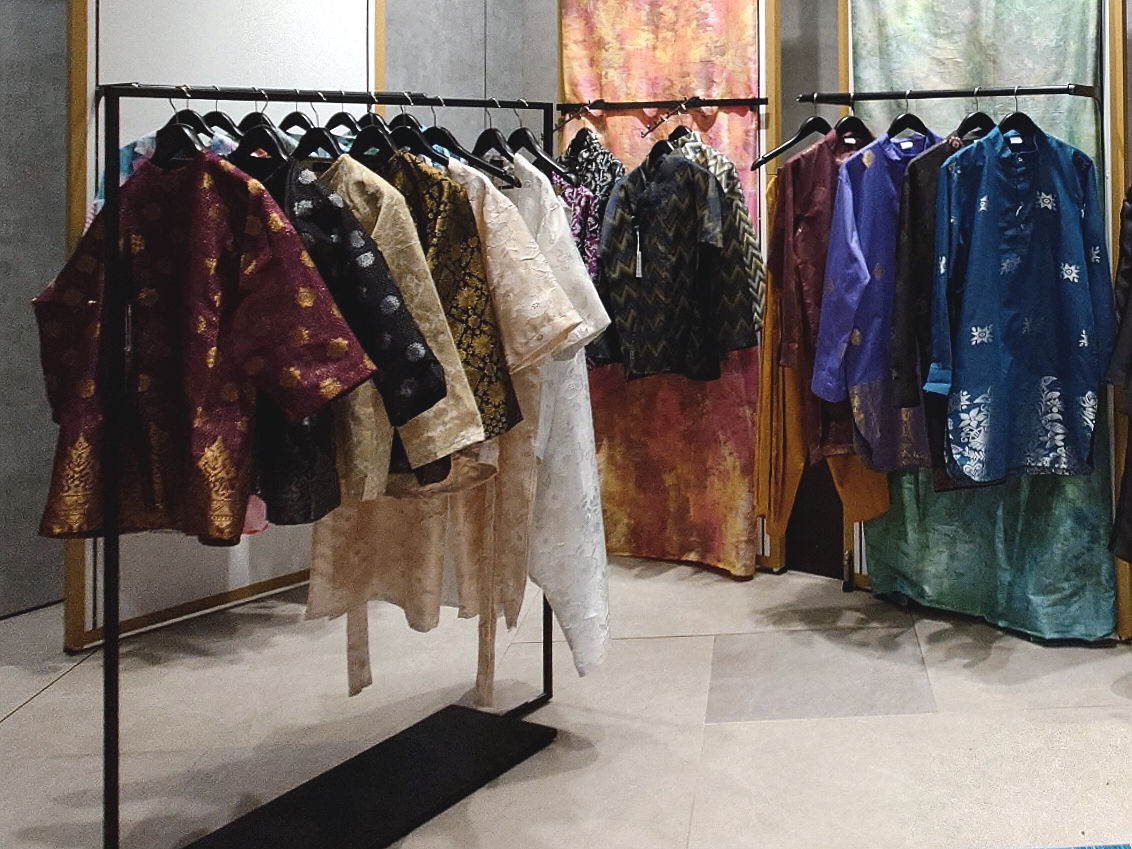
The dressier styles of Sawang

Angelique’s unspectacular florals and prints
A look at Behati truly tipped us into executing a flashy dive into the pool of conclusions. But we wanted to be fair. We examined Behati’s immediate neighbour Sawang. Founded in Penang in 2017 by Lee Tche Fuh (known socially and professionally as Zack), the clothes have an unmistakable Chinese identity, except that the pieces are made with semblances of traditional Malay fabrics. As it is a Raya capsule, the silhouettes are closer to the baju Melayu’s. Mr Lee, a photographer too, is known to be a fan of the 汉服(hanfu. Online, Sawang is identified as “槟城华服设计/定制 or Penang Chinese fashion design/made-to-measure”), who enjoys “male photography”, we were told (he is, and it is easily seen on his socials, not opposed to using himself as model in his communication materials, much like Tan Kel Wen). Through Sawang, he brings his two loves together like a village Mapplethorpe might, only the shirtless men—and Mr Lee, too—wear sarongs. The make of the clothes are discernibly better than Behati’s, but the costume-y style does not quite set it apart from the trending KL label, loved by the likes of singer Aini Abdul.
Next to Sawang is Eric Choong. A veteran of the KL fashion scene since the late-’80s (he was also a fashion stylist in the early years), Mr Choong has in recent times concentrated less on fashion design in favour of organic fabric dyeing and art. The pieces available at Design Orchard are too few for us to say that there is strength in the designs, which are mostly flat-cut, oversized and over-long (as in Peranakan baju panjang) shirts. We are no fan of the inky blotchiness of the prints, but the finish of the pieces are what would be considered garmental. The sole female designer Tan Pei Ling (known socially and professionally as Pei) fares not better then the men. Angelique is, at its core, a gift-shop brand. Ms Tan runs a “boutique hotel” (online, the setup is described as a “boutique bed and breakfast”), You Le Yuen (釉乐园), situated in George Town’s somewhat seedy Love Lane. The Angelique store is part of the property and the eponymous merchandise appear to cater to holiday makers who adore easy yet sassy, exotic clothes to roam about in. In that vein, Sixth Sense on Beach Street (also in George Town) is more contemporary and, to a degree, more compelling.
Riang Ria Raya allowed us the welcome look at what some of our neighbours to the north are doing to upraise their nation’s lure as a fashion destination. We have no doubt that there are solid clothing labels in Malaysia, but those seen in Design Orchard at the pop-up are not them. While Design Orchard welcoming brands from across the northern border could be a favourable strategic move or one that resulted from a lack of good, Made with Passion labels on our shores, stocking brands that do not augment what scant quality the store has tethered itself to is no shot in the arm. Jolly good is not good enough. Design Orchard has to aim higher; they deserve better. We shoppers, too.
Photos: Chin Boh Kay
 Style on the Dot