It is at the heart of a deep political scandal after the country’s first lady accepted it as a gift even when she was not seen in a video shared online to have received it with her own hands
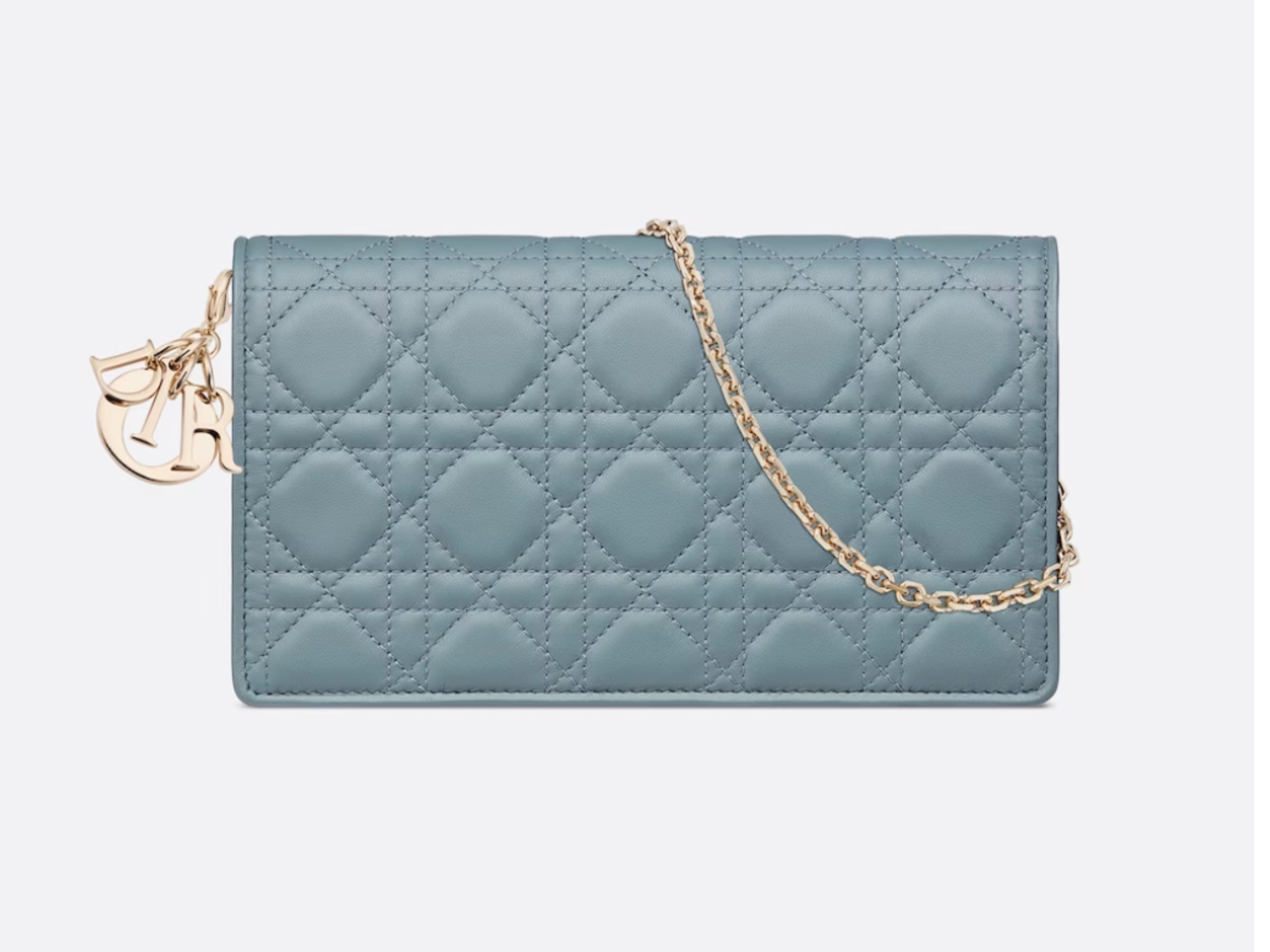
Lady Dior Pouch. Photo: Dior
The slim calfskin bag seen above is a Lady Dior Pouch. It is in a shade that the brand calls ‘Cloud Blue’ and is top-stitched in the maison’s popular signature ‘Cannage’ grid repeated pattern. On one side of the oblong bag, a detachable gold charm that spells out the four letters of the name dangles. This teasingly simple and discreet (by Dior standards, anyway) clutch—or shoulder bag if the supplied gold chain is used—is now the talk of South Korea after president Yoon Suk-yeol’s attractive wife Kim Keon-hee allegedly accepted the satchel as a gift. According to Korean media, one purportedly “pro-Pyongyang” Korean-American pastor named Abraham Choi Jae-young came to see Ms Kim in September last year (four months after her husband took office), bearing the bag that was not wrapped in fancy paper, but in the unmistakable white Dior paper bag. The gifting of the bag to the first lady came to light when it was shared in a news report—viewed 459k times—by the left-wing Voice of Seoul on their YouTube channel.
In the reel that appeared in the report, Mr Choi—apparently wearing a camera affixed on his watch—filmed the purchase of the Lady Dior Pouch at an undisclosed shop in South Korea. The sales person, wearing a black glove on her right hand, was seen showing the bag as well as it contents, which included what Dior described on their website as “two removable elements: a card holder and a zipped pouch”. A hand from the side of the videographer reached out for the price tag and flipped it over. The camera zoomed in on the price of the bag, which showed 3 million won (here, it is retailed at S$3,400). The video then cut to the view of the Dior paper bag on what appeared to be a work desk in the office of Covana Contents, a company founded by Ms Kim, and where she served as CEO. According to local media, she asked the giver in Korean, “Why do you keep bringing me these things?” It is rather curious that, to her, it is not unusual that a priestly being should come acalling bearing luxury gifts. Although the person whom the gift was intended was not seen receiving the present, it is believed that the bag was accepted. Perhaps more pertinent was the suggestion in her question that the pastor has brought other gifts, previously.

Headline news as seen in the Voices of Korea YouTube broadcast. The text reads: “First Lady receives luxury gift” and “First Lady, Dior and the Hidden Camera”. Screen shot: voicesofkorea/YouTube
Although the shaky video was broadcasted two months ago, it re-emerged recently and aroused more interest in what it potentially meant, leading to the suspicion of graft among Koreans. According to The Korea Times, “the head of Voice of Seoul has since filed a complaint with the prosecution accusing the presidential couple of bribery.” The clandestine operation was supposedly supported by Voice of Seoul—they provided Mr Choi with the camera (and, presumably, the money to purchase the bag). A Yonhap News Agency editorial even suggested that the pastor “conspired” with the YouTube news site to carry out the sting. This was not the first time that Voice of Seoul had wanted to expose Ms Kim. Yonhap News Agency reported last year that in the runup to the presidential election, the Internet channel, as well as the broadcaster MBC “aired recordings of phone conversations Kim had with a Voice of Seoul reporter after a court rejected Kim’s injunction to stop the broadcast.” The tapes apparently “contained criticism of the previous Moon Jae-in government and remarks on some politically sensitive issues.” Voice of Seoul, known to oppose the Yoon government, was ordered by the court to pay 10 million won (about S$10,039) in compensation to the first lady.
Abraham Choi, who has ministered in North Korea (the media called it “religious exchanges”), claimed that he and the president’s spouse are family acquaintance. He sought to seek an audience with Ms Kim to express concerns over her husband’s hardline policy towards the Korea in the north. And to secure the meeting, he thought the gift that incurred no small expense was necessary. In fact, in his initial contact with Ms Kim (the face-to-face that involved the Dior bag was the second), he did not go empty-handed either: She was presented with Chanel cosmetics to the tune of 1.8m won (or S$1,806). Seemingly, Ms Kim did not reject them, which led Mr Choi to conclude that an in-person session with the first lady required such a material gesture. “You might say they were like an entry pass, a ticket for a meeting,” Reuters quoted him saying. Supporters of the Yoons, however, insist that the first lady was a victim of a an elaborate plot to sully her name. Yonhap News Agency cited a presidential source who said that the pastor “had deliberately approached Kim with the intention of illegally filming using his family connections.” There was no denying what Mr Choi brought to Ms Kim’s office were received, but “that gifts to the couple are handled and stored as property of the government.”

King Charles flanked by President Yoon Suk Yeol and First Lady Kim Keon Hee at the investiture to present Blackpink with honorary MBEs. Photo: Reuters
It is not clear if the first lady loves Dior bags or fashion, or both, even when she is known to support under-the-radar local brands. Or, why the pastor chose the brand to induce her to step into a potentially problematic situation. Ms Kim is known for her fashion sense. She is noticeably unlike past presidential wives, in that she does not stand back from the spotlight—politically, socially, or sartorially. She does dress rather sharply, with a penchant for well-cut suits, flattering dresses, and a judicious use of jewellery. Her striking style has been lauded by the international media, especially when a photo of the president and her with King Charles and Blackpink during the investiture to present members of the pop group with MBEs. Ms Kim looked as good as, if not better then, the pop stars. In fact, so notable and likeable her turnout has been through the years that there is even an ‘official fan site of Kim Keon-hee’ on Korea’s largest web portal, Naver. And also a Facebook fan page ‘Keon-hee sarang (or love for Keon-hee)’ that shows images of her life beyond the gates of the presidential palace. Despite her comely public images, the 52-year-old is not alien to public contention. The earliest was a decade ago when she was embroiled in the allegations of stock price manipulation. Then there was the recent claims that plagiarised passages could be found in her Ph.D. thesis, as well as “falsified” professional records.
The Lady Dior Pouch at the centre of the controversy is a spin-off of sort of the first and most recognisable Lady Dior. It came into being in 1994 while the late Gianfranco Ferré was creative director of the house (when he left, he was replaced by John Galliano). At its birth, the flapless bag (it is almost a mini-tote) did not really have a name, only a working title Chouchou (‘The Favourite’, in French). A year later, when Lady Diana, Princess of Wales carried one on a trip to Paris, to attend the Paul Cézanne retrospective at the Grand Palais, it became Lady Dior, clearly to ride on her fame. Later iterations of the bag continue to be distinguished by the graphic Cannage pattern. The made-in-Italy Pouch was introduced in 2020, and became popular among fashionistas for its compact size. It is not known why the Lady Dior Pouch was selected by the pastor, rather than, say, the even more popular Book Tote or the more unique Saddle Bag. Regardless of the choice, the very fact that an expensive Dior bag was offered as meeting gift prompted many Koreans to think that graft was at play. So far, the Yoons have been silent rather than apologetic about the allegation. With an election approaching, it may not serve them well to remain that way.
Update (11 June 2024, 9am): According to The Korea Herald, the nation’s anti-corruption agency said that they had closed the inquiry into corruption allegations against the first lady as they found “no violation of the law”
 Style on the Dot