It is still Southeast Asia’s largest. And possibly the most engaging

Entrance of the expanded Muji store at Plaza Singapura

Visual merchandising at the entrance is now more compelling than before
In 2017, Muji (無印良品 or Mujirushi Ryōhin—literally, ‘no brand, quality goods’) opened a store in Plaza Singapura that was large enough to enjoy being touted as a flagship. At 1,896 sqm, it was indeed large—not by Japanese standards, but certainly by the typical store size of many retailers here. But presently, with an enlarged space—a 3,530-sqm expanse, which is nearly twice that of the original, it is not only this island’s largest Muji, it is, as the brand proudly states, “Southeast Asia’s largest Muji Global Flagship”, a position it held with the store preceding this (the space is only slightly smaller that the Ginza flagship in Tokyo, standing at 4,000 sq m, spread over 7 floors). And by that, they mean Muji is now stocked with more merchandise, includes services that were not previously available. The store is still situated at the far-end of Plaza Singapura, but now includes the adjacent space formerly occupied by the Chinese fashion brand Urban Revivo. As we have mentioned before, Muji has become a veritable department store, so large and so compelling that they easily replace traditional—and stagnated—players, such as Tangs and Metro.
Aesthetically, you are in familiar territory. Whether in Tokyo or Bangkok or here, a Muji store is unmistakable, regardless of the size: woody warmth within an industrial shell. The refurbished Plaza Singapura space is a gathering of what Muji does best, separated into zones that are characterised by their welcomed glow. The entire store is arranged almost in a grid, which makes navigating it easy and instinctive. Together with wide aisles, the orderly layout (until the throng, especially the hungry crowd eyeing Muji Cafe, descends), would appeal to those who come with families and seek spaciousness while strolling. At a glance, what is, perhaps, a little different, is the visual merchandising that greets you. We don’t always get mannequins and propping to front a Muji store. But here, there are tableaux (perhaps, it’s the holiday season) that congenially communicate the store’s merchandise mix and its particular appeal.

The men’s department no longer in the shadow of the women’s

Muji Labo, a design-forward largely unisex sub-brand, has its own distinctively boutique-like space
For a “no-brand brand”, Muji is strong on aesthetical messaging. The simple and ‘clean’ merchandise belies the company’s refined approach to product design and development, that, to us, place equal emphasis on function and the attractiveness that is decidedly urban. Some critics (non-fans, namely) call Muji’s mark of minimalism soulless. But in a world where brands are continually screaming to be noticed and bought, Muji’s approach is a refreshing antidote to showy consumerism. In 1980, when it was first launched as a small product line under the Japanese department store Seiyu (now owned by the American chain Walmart), Japan was considered to be a brand-conscious society, much like China is—and we are—today. Muji’s quiet merchandise was not, at the time, thought to have long-term appeal, at least commercially, but it prevailed, 43 years on.
On our island, Muji failed just two years after it opened in 1995 (partly due to the woeful economic climate then) at the now defunct Liang Court. When it came back at the also no-longer-operating Seiyu department store at Bugis Junction (the space is now occupied by BHG) in 2003, the brand was very much welcomed, and that store-within-a-store has since catapulted to the (growing?) flagship at Plaza Singapura now. Muji, through this new retail biggie, continues to show that Nippon minimalism is not necessarily devoid of spirit or sophistication. And that one can easily emulate Marie Kondo’s domestic organisational and decorating flair with what Muji offers. Ikea may still be tops in terms of furnishing preference here, but not everyone desires Swedish or Scandinavian cheeriness when it comes to home comfort. Muji’s straightforward orderliness is enticing counterpoint to Ikea’s Euro-swank, even if both enthusiastically help you keep clutter away. But Muji is not only facing competition from the Swedes, it is now a direct opponent for fellow, sometimes-cheaper, Japanese brand Nitori.

The new, full-scale Muji Renovation service

The show space that mimics a “typical” flat of our public housing
What is new here is the service Muji Renovation that offers full residential refurbishment. This is not just a decorating service (as it was before), but a complete ID deal that comes with design solutions as well. Included in the zone where furniture and furnishings are available is a mock-up apartment that we have not seen in a Muji store here (Ikea, as fans know, is frequently visited for their walk-in-and-explore show flats). The sole show apartment at the rear of the store is a model of a HDB ‘four-room’ unit of an indeterminate estate, boasting 1,045 sq ft (or about 97 sq m), that is not only furnished with the brand’s own products, but is also given Japanese solutions in areas that regular fixtures, for example, are not easily homed. A helpful staffer explained some of the Muji-conceived details, to us, such as overhead lighting units that can double as shelving. She shared that, except kitchen cabinets and some wood fixtures, everything else in the design package is provided by Muji. When we asked her if it would be expensive for a flat to be Muji-appointed, she replied, “not really. About S$65 to S$75 per sq ft (or per 0.09 sq m).”
For the first time, too, Muji has included the offerings of local retailers in their space. One standout corner is Ascent Bikes, a seller of customisable two-wheelers, founded in 2019 by former engineer Qing Xiang Yee, who called his business “a hobby that I got carried away with.” The brand touts its “relentless focus on innovation and pushing the boundaries of road and urban cycling”, and is popular for its Mini Velo, a small bike with “typically” smaller wheels (20 inches or about 51 centimetres) that “excels in the city”, which also means it is light enough to be carried up the stairs of overhead bridges or stored away in an apartment (we wish they offered a storage solution for the bicycle in the Muji show flat). It is not certain if one can try the bikes on display (it is tempting to ride in the generous space of the store), but it is likely that trial rides elsewhere could be arranged at their Yishun HQ. Apart from the bikes, there are also accessories that can help you distinguish your vehicle from others, as well as—as seen on mannequins—cycle wear that Muji happily proposes.

The Idée space, featuring decorative products, is retained
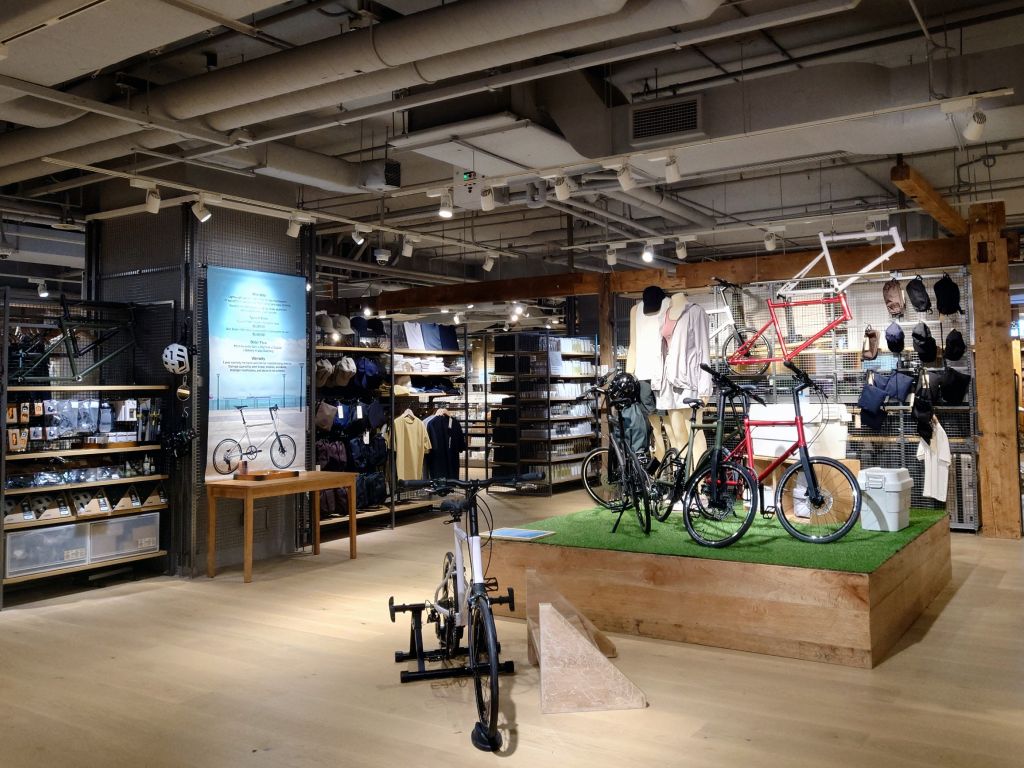
New to the store, bicycles from local retailer Accent Bikes
There is also the Muji Community Market, once a seasonal offering, but now with its permanent space. Here, Muji introduces products from less known areas of Japan, as well as other parts of the world. Presently Ehime, a prefecture in the north-west of the country, is featured. For those not travelling to Japan like the hordes are, this exhibition will encourage souvenir shopping even without leaving home turf. Just as engaging—and still around—is Idée, the corner (now smaller) that offers decorative ideas to awaken the more sedate Muji furniture and such. The brand describes Idée as a project that promotes “comfortable lifestyles… with aesthetic values for fun”. Also re-establishing itself here is Muji Labo, the house label that promotes a “shared wardrobe”, which persuasively shows that clothing can be gender-neutral, eye-appealing, and non-controversial. Muji Labo is popular among those who appreciate simplicity that does not disregard cut, shape, and make. Oftentimes, there are pieces that would not stick out in a wardrobe filled with Jil Sander or, now, Phoebe Philo.
As well stocked and varied the merchandise mix is, the Muji flagship isn’t quite a faithful Japanese transplant. Yet to be introduced into the market here is Muji Books, a different retail unit usually situated within a Muji store. The books are part of the brand’s simple lifestyle mantra “living with words” and could, in fact, easily be the stuff with which to fill Muji’s various shelving units and, as a result, form the decor of the home set-up. Possessions, it has been said, characterise—even distinguish—one’s domestic/personal space, and the long-reads, as Muji proposes, “offer you life in connection with books”. Outside Japan, Muji Books is available in Taipei, Hong Kong, and Shanghai. Its glaring absence here speaks volumes about our reading population, or, regrettably, the lack of.
Muji flagship store is on level one, Plaza Singapura. Photos: Galerie Gombak
 Style on the Dot