Participants of Singapore Stories 2023 this year enthusiastically answered the call for Kebaya Reimagined. The traditional baju was reinterpreted, rehashed, refreshed. Was any of it cantik?

The finale of Singapore Stories 2023.
This year, the sixth Singapore Stories was not a competition—not as it was before we, with an eventual winner. Singapore Fashion Council (SFC), which organised what would have been the finals of a contest as the evening’s entertainment (or “key programme”) of their “inaugural gala”, described it as “a celebratory showcase of 30 Singapore fashion designers in one stunning, multicultural fashion runway show”. But what were they really commemorating? On the SFC Instagram page, they wrote that at the festal pomp, they “relished in our iconic regional garment—the kebaya—during this year’s theme ‘Kebaya Re-imagined’”. On the choice of the theme, SFC shared on their website: “Coinciding with the re-opening of the Peranakan Museum, as well as NHB’s multinational nomination to inscribe “Kebaya: Knowledge, Skills, Traditions and Practices” on the UNESCO Representative List of Intangible Cultural Heritage (ICH) of Humanity in end March 2023, Singapore Stories is of the moment—marrying future fashion with reflection and celebration of this unique cultural heritage.”
The Singapore Stories thematic bent may have given the Peranakan Museum (including the controversial-near-the-end-of-its-run exhibition Her Kebaya) a marketing helping hand; it may have bolstered the UNESCO nomination, but it isn’t so clear that the output of the selected thirty “is of the moment” or that it jibes with what might be considered fashion that has far-reaching appeal—beyond the shores on which the kebaya means something. Just as curious was expecting our designers, not all even affirming modernists, to be able to bring “future fashion”—what this really is was not defined—into a union with an article of clothing deemed a “cultural heritage”. It was hard to see that the designers reconciled the stylistic traditions of the past with the aesthetical possibilities of the future. For most, they merely wayang-ed (faked) their way through. An earlier sell of the gala, also on IG, urged: “Be a part of our history at our inaugural gala—a mesmerising celebration of fashion”. It was a lineup of startling mediocrity.

Entries of the top five Singapore Stories by—not in order of merit—(clockwise from top left): Anseina Eliza (Ans.ein), Madhusha Samy, Adele Chung (Meiko Tailor), Kassandra Lim, and Kavita Thulasidas
Staged at the ballroom of the Pan Pacific Hotel exactly a week ago, the SFC gala could pass off as a quasi-government symposium. Or, a National Day celebration with grassroots leaders. If not for the runway—itself an oddity, a stretched parabola at the end of the ballroom with an upper of Tiffany blue(!) carpet, the setup could easily be mistaken for something else. One of those investment workshops conducted by some voluble guru, such as Chloe Lin, peddling the Ultimate Portfolio Game Plan? When we asked around, we were told that there was “no budget” for the event. A very old regret. And the thin, unfashionable backdrop? “No budget”. As to why the past competition format of Singapore Stories was not followed, “no budget” came rapidly too. It is rather sad—even depressing—that after four editions of what has been the only way to “take home the prestigious Singapore Fashion Awards” for the winner of the contest, the event was, by way of financial support, still basically hanging by a thread.
No Singapore Fashion Awards were handed out this year. Rather, a quintet of designers were picked as the “Top 5”: Anseina Eliza (Ans.ein), Madhusha Samy, Adele Chung (Meiko Tailor), Kassandra Lim, and Kavita Thulasidas (Stylemart), Singapore Stories 2022 winner, fresh from her debut in Paris. If the competition aspect was omitted this year (it isn’t known if this is permanent), what were these designers—some budding, some not—judged on? How was one outfit able to represent the design thinking behind the ensemble that was supposed to be based on a theme? Or was it really a popularity poll? A considerable number tried not to approach the kebaya as costume and, as such, their reimagined designs must not buckle under the yoke of tradition. There were, naturally, those who preferred the obvious. Worse are those whose reimagining was so jokey, they could not escape ridicule. Whichever way, the sum was not of refinement, but a rojak with too much sauce and little else. A good nyonya cook would ask, “boleh ka sedap”—can it be good?
…the sum was not of refinement, but a rojak with too much sauce and little else. A good nyonya cook would ask, “boleh ka sedap”—can it be good?
“Watch as models strut down the runway in stunning, one-of-a-kind pieces that draw inspiration and innovate upon the Kebaya,” SFC beckoned on IG. One of a kind they were, but there was no other way the clothes could be when the designers were limited to one submission, one look. It is admirable that SFC was confident that the participants would “innovate on” the council’s chosen garment, but innovation is not a handful of sequins—just scatter and hope they fall attractively. The show was a cultural procession, and we sensed a main masak-masak (play-play) vibe—even elation—in how the clothes came to be. While some had delved into a smattering of research or incorporated the handwork that the Asian Civilisations Museum loves to call “handicraft”, the end result was mostly a case of eager to impress, but impressive it was not. The question that beseeched to be asked the whole night: What did Singapore Stories really say about contemporary Singaporean culture that is not the Chingay?
When we think of an ethnic dress reimagined, many come to our mind, but one is especially memorable. Two, in fact. They are a pair of couture kimonos worn by Madonna in the Johan Renck-directed music video of the immensely danceable 1998 single Nothing Really Matters, from the album Ray of Light. Both were designed by the now-largely-retired Jean Paul Gaultier—the singer’s frequent collaborator. The first is a kimono of two different fabrics: silk for the body and PVC for the eri (collar), the sode (sleeve) and the obi (sash). The second is a cropped version in crimson, and worn with matching shorts, and PVC obi. Those two sets of kimonos were indeed reimagined. The traditional form of the garment largely remains, but the use of the fabrics, without print or embroidery, clearly gives the kimonos a modern edge. And worn with the collar gaping, revealing no nagajuban (underclothes) beneath both, suggests a perverseness that comport with the antics of designer and singer. The classic and the radical in conjugal bliss.
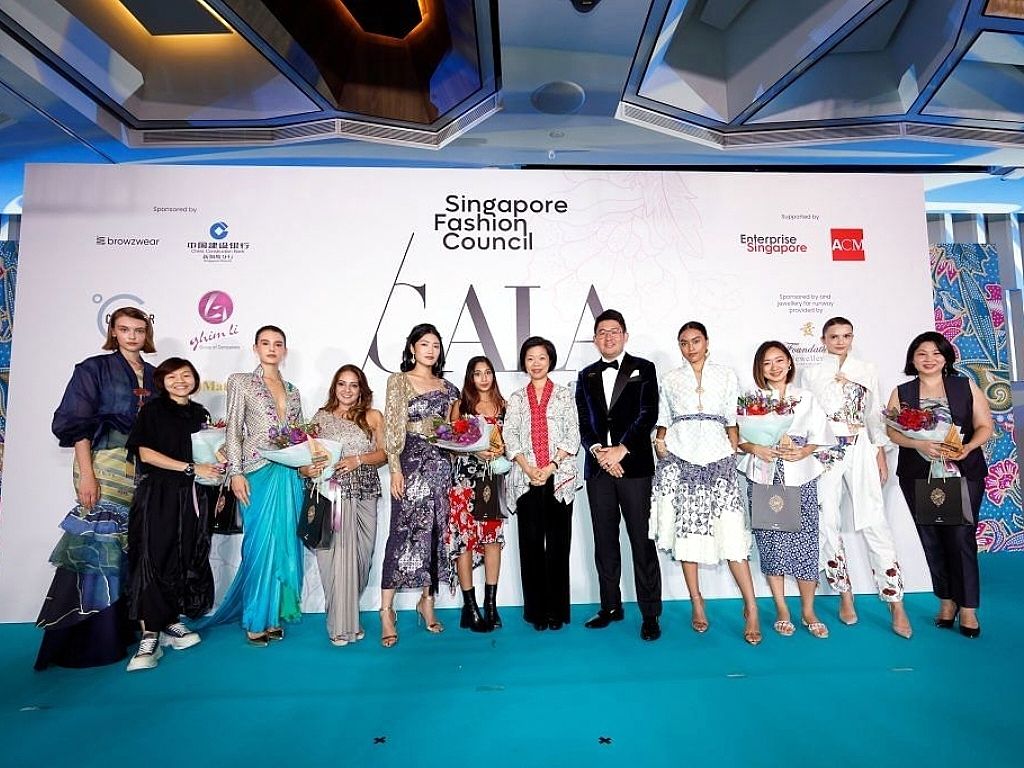
The happy bunch: (from left) model and Kassandra Lim, model and Kavita Thulasidas, model and Madhusha Samy, Senior Minister of State and patron of SFC Sim Ann, president of SFC Wilson Teo, model and Anseina Eliza, and model and Adele Chung
Singapore Stories breed neither creative classicism, nor radicalism. The event fosters storytellers of no compelling narrative and envisions a future ensnared in the past. Under SFC’s watch, Singapore Stories appear to pursue the ethnic angle when it comes to what truly defines SG fashion, if it can indeed be defined. But can traditional dresses or a mashup of them really set our cerita apart? We do not dream for Singapore to be London or, closer home, Tokyo, but we are hopeful that, given the confluence of generative influences, such as taste cultivation and distal thinking (not everything is pegged to the past), a potent creative class could be birthed. It is laudable that SFC has given these designers a chance to do a fashion show, for their expressions to be displayed. But many have never seen a fashion show before, let alone have their clothes paraded on a catwalk. And, last week, it showed.
In the face of the highest inflation in a generation and deadly geopolitical tensions across two continents, it is hard to see what Singapore Stories was promoting was worth wanting. Or, one day, destined for a museum exhibition. Or, looking further, would fetch handsome prices on Grailed. Perhaps the show met its objective if the fashion choices of the gala’s guests were any indication. The ‘Kebaya Reimagined’ theme was extended to the dress code. But reimagination was very absent. A significant few turned up as Emily of Emerald Hill (or attendees to a Gunong Sayang Association party). One woman actually appeared in a fake Singapore Airlines air stewardess’ uniform. Design Orchard’s CEO Semun Ho was a little too early for Deepavali. ACM’s Kennie Ting, a proponent of seeing fashion here through the lens of our being a port city, wore a batik shirt, looking suitably ministerial.
Singapore Stories were not only recounted at the Singapore Fashion Council gala. This season, from Grace Ling in New York to Kavita Thulasidas in Paris to Frederick Lee in Busan, they were eagerly told, and through different voices. But, is anyone—in Singapore or outside—really listening?
Photos: Singapore Fashion Council
 Style on the Dot