Fashion weeks are increasingly less about the collections and more about the star-attendees, both on stage and off, especially in the front row
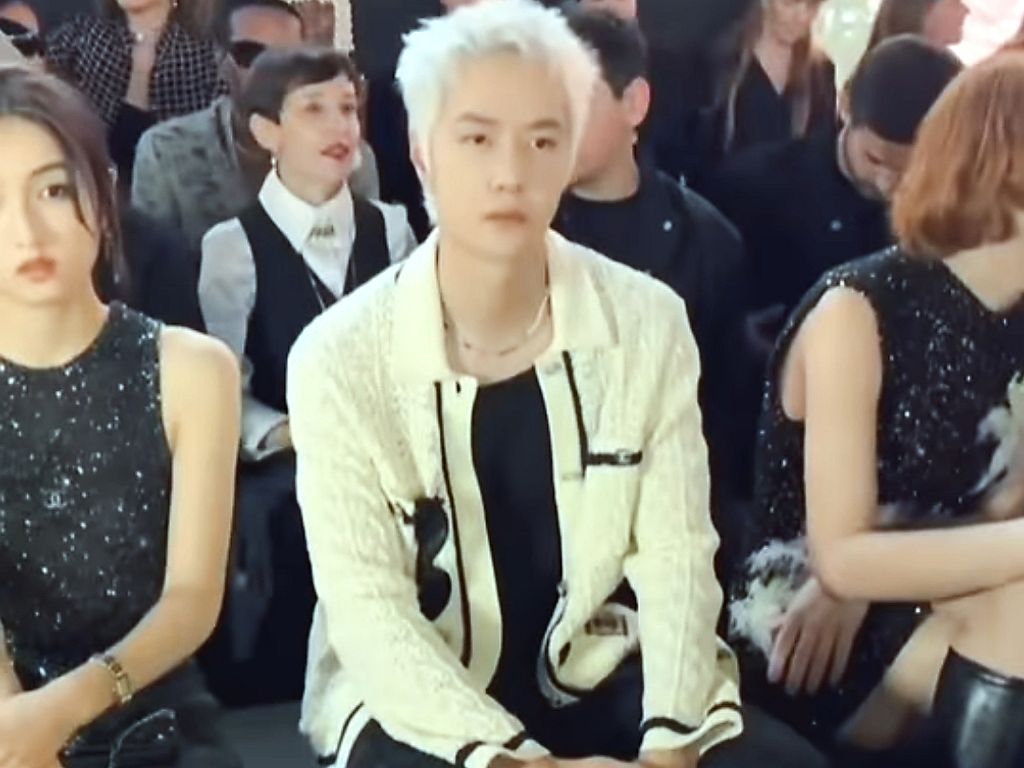
Chinese star Wang Yibo (front centre) in Chanel, at Chanel on the final day of PFW. Screen shot: chanel/Instagram
No matter in which of the big four cities, fashion weeks this spring/summer season seemed more a celebrity circus than an industry event. Critical show coverage in the press has frequently given way to who attended which show, and whether they were lead-story-grabbing enough. The common headline, regardless of title or news site, has been “All the Celebrities Spotted at __________ (chose your fave fashion week)” or “The Most Stylish Celebrity Arrivals at…” What is increasingly (and also irritatingly?) “celebrity moments” and their “must-see fits (a word we dislike, intensely) seem more newsworthy than what these famous people came to see. In fact, they did not come to see, they came to be seen. As Elle noted: “While whatever is on the runway can be totally awe-inspiring, it’s often the front row that catches our eye.” Awe-inspiring, as it turns out, is not eye-catching. Or, enough.
And if the front-row (“or the FROW, as [Elle] likes to call it”) action is insufficient, you can start with the arrivals. For most of us, watching the livestreams is the only way to catch the runaway action. But it is a known fact that no show starts at the advertised/scheduled time—none. So you end up looking at the stars streaming into the venue, posing as soon as they get off a car or at a tacky, over-branded photo wall, waving at gawkers, or chatting with fellow show-goer/celebrity. This sometimes goes on for more than 30 minutes, even 50. But the sight of, say, Blackpink’s Jisoo (at Dior), is usually fleeting. In the mean time, the message “the show will start soon (now in different languages, including Asian—Chinese, Japanese, Korean)” appear, again and again. The celebrities, whether eye-catchingly dressed or not—fill the screen of your smartphone, tablet, or PC, like digital ghosts. Those watching the livestream from across the world, specifically in Asia, where the show could be broadcast in the wee hours of the morning, could be doing so, bleary-eyed and unamused.

Blackpink’s Jisoo arriving at Dior last month. Screen shot: Dior/Instagram
Brands are into the game too. You now often see such notices in your news feeds: “Getting Ready for the __________ (choose your fave label) spring/summer 2024 show with __________ (choose your fave star)”. This usually appears after the runway presentation. It’s a link to a YouTube post—a scripted video that shows an actress (or singer) prettifying herself in her hotel room, with assorted clothes (or/and cosmetics) from the brand. Unheard of are the celebs who wear their own clothes. The conversation in the reel is usually one-way and inane, the entire procedure eerily calm. Or, there could be very-dressed-up stars visiting the atelier prior to the show, looking at the clothes and garment-making processes, under the guide of a brand’s staffer, with goofy delight. Asian stars, some limited by their ability to speak non-native language, would go from “so pretty” to “so pretty”.
According to Vogue Business, “celebrities represented 57 per cent of total visibility (or earned media value or EMV), generated by the top 12 fashion brands in the first nine months” of this year. The presence of stars are, therefore, crucial to any label’s branding exercise during fashion week, and crucial to the brand’s visibility across social media. According to findings by French influencer marketing platform Lefty (their clients include Chanel and Dior) this season, Kylie Jenner, in just two appearances—one for Schiaparelli and the other for Acne Studio—generated an EMV value of US$26.6 million (about SGD36.3 million). Among the Asian stars, Thai actor Nattawin Wattanagitiphat (aka Apo) ranks first (and third in the global ranking) just by showing up at Dior, with an EMV of US$9.7 million. But these stars are not simply invited to the shows. They are paid to appear. The remunerative gains are part of secret negotiations. No one know who gets how much, except that it runs into tens of thousands (or even hundreds) of dollars (USD), per show (video appearance would probably incur a higher fee for the brands). Stars boosting the popularity of fashion shows have become a business, not unlike Mediacorp actors promoting bak kwa.

On the runway: Li Haoran for Balenciaga and Fan Bingbing for Mugler. Screen shots: Balenciaga /YouTube and Mugler/Instagram respectively
But not all recognisable faces keep their backsides adhered to the benches of the front rows. Some place themselves higher, taking to the runway instead. This season, two mainland Chinese stars stood out: Liu Haoran (刘昊然) at Balenciaga and Fan Bingbing (范冰冰) at Mugler. Mr Liu took to the runway, looking somewhat listless. Perhaps he already heard by the time he strolled on during the show that Netizens from his homeland were disgusted by his performative appearance for a brand that they consider disrespectful of the Chinese consumer (in 2018, Balenciaga staffers reportedly assaulted a Chinese shopper at its Printemps, Paris store. It is not forgotten). To make matters worse, Mr Liu’s Paris runway debut was on 1 October, which was 国庆日 (guoqingri), China’s National Day. Fan Bingbing, an actress on indefinite hiatus (after her tax evasion scandal, also in 2018), did not fare better, strutting the wind-blown Mugler runway in an outfit that would have been nothing if not for the long, sheer fabrics flapping behind her as she gallantly walked against the artifical blast. On the social media platform 小红书 (xiaohongshu), her compatriots pitched her against Anok Yai, comparing her “body shape” to the leggy Sudanese-American model. She did not score favourably.
Back at the front row, more male movie/pop stars were appearing at womenswear shows, especially those from Asia. At Chanel, although they don’t present menswear per se, they invited quite a few male celebrities to their front row, including an oddly elderly-looking Wang Yibo (王一博), the Luoyang-born actor/singer/road bike racer, also once a member of the K-pop band Uniq. Mr Wang attended the show wearing a Chanel woman’s cream-coloured cardigan with polo collar; he did not look naturally at ease, or that he belonged. But other than the male stars, a few magazine editors, too, have been positioning themselves as individuals that are equally celebrated. One of them, who is from our shores, diligently shared photographs of not only himself at these shows, but also with stars, as if they are chums, or fellow luminaries. We have to remind ourselves that in a world that emphasizes inclusivity, everybody can be somebody. Ten years ago, anyone could be a model, and then an influencer. Now, anyone can be a celebrity. How crowded the dazzling space is.
 Style on the Dot