Finally
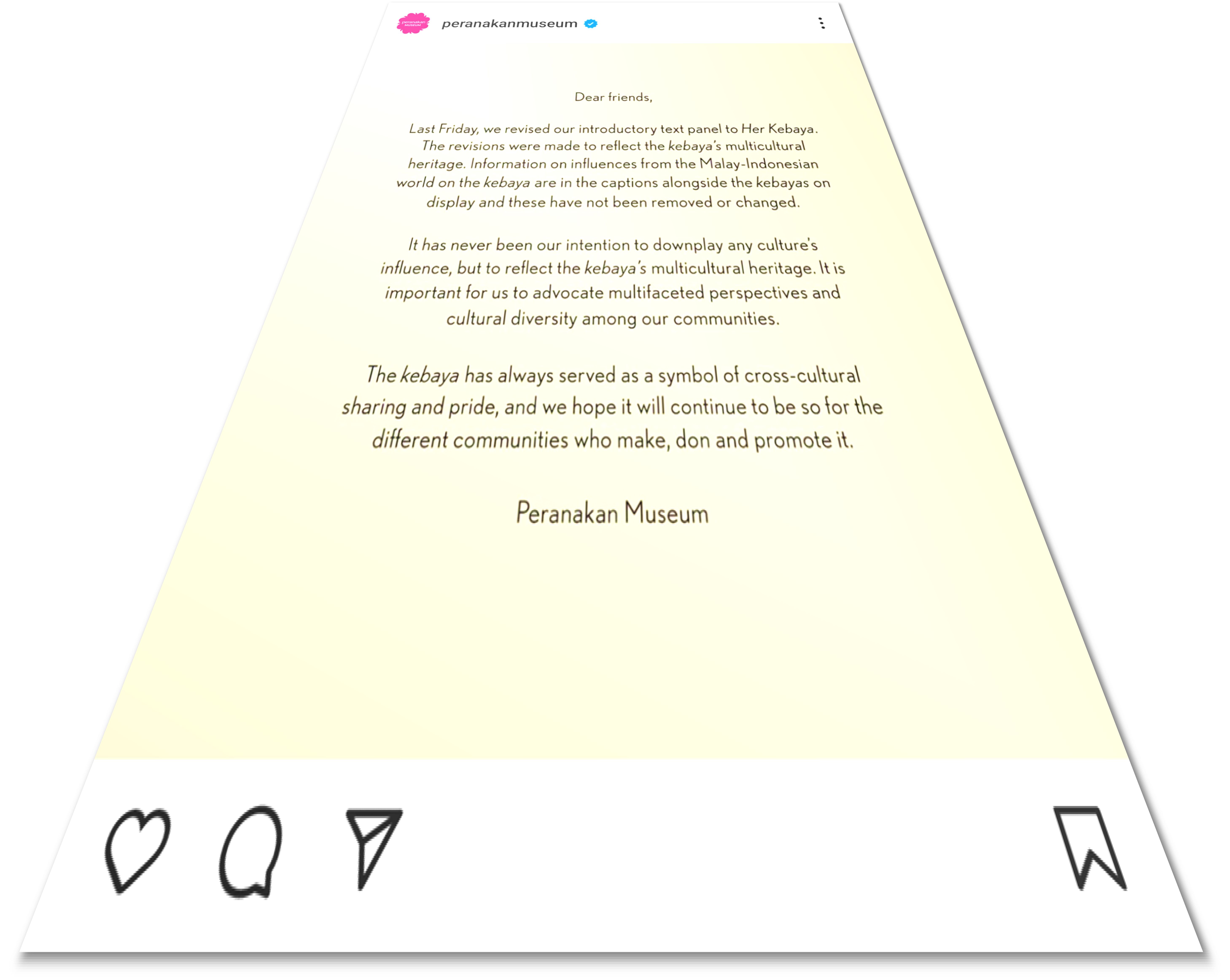
The TPM message on Instagram. Screen shot: theperanakanmuseum/Instagram
Last night, at the relatively late hour of nine, while we were preparing to watch the Gucci livestream, a little sunbird told us of a new post on Instagram by The Peranakan Museum (TPM). On the museum’s page, the latest entry was a visual in the form of a text message. It appeared that TPM was shedding light on their recent late-into-the-exhibition amendment of the introductory text used in their description of the mini display Her Kebaya. At last. To be certain, this was no apology to their inelegant action, but a sort of marginal note, explaining why they made those changes to the text, first publicised by Instagrammer Haider Surya Sahle and subsequently in an editorial by Wake Up Singapore.
Mr Sahle created his IG post on 16 September. TPM claimed that the changes to the said text was made last Friday—just a day before Mr Sahle shared his observation on IG (was his visit to the TPM really that timely?). It has taken TPM a week to address social media users’ displeasure as they reacted to that IG post. The museum stated that “the revisions were made to reflect the kebaya’s multicultural heritage.” Possibly fearing that the Malay community might feel disregarded by not stressing their links to the kebaya, usually worn as a set, the sarong kebaya, it assured that “information on influences from the Malay-Indonesian world on the kebaya are in the captions alongside the kebayas on display and these have not been removed or changed.” It is surprising that TPM is unable to see the significance of body text over captions.
“It has never been our intention to downplay any culture’s influence, but to reflect the kebaya’s multicultural heritage,” TPM went on to say. It did not identify the cultures that influenced the kebaya’s aesthetical makeup. Nor did it answer Mr Sahle’s question: “Why amend the text just a month before the exhibition ends?” Did they, in fact, come to the awareness of this “multicultural heritage” belatedly? Making sure to underscore inclusivity, TPM continued: “It is important for us to advocate multifaceted perspectives and cultural diversity among our communities.” And that “the kebaya has always served as a symbol of cross-cultural sharing and pride,” strangely avoiding the kebaya’s cross-border significance when they decided to take out “rooted in the traditional fashion of the Malay-Indonesian world”. It concluded by saying, “we hope it will continue to be so for the different communities who make, don and promote it.” Bagus?
 Style on the Dot