Even when the collection was presented in a space with the surface area of a swimming pool. But did Gucci just collaborate with Valentino?
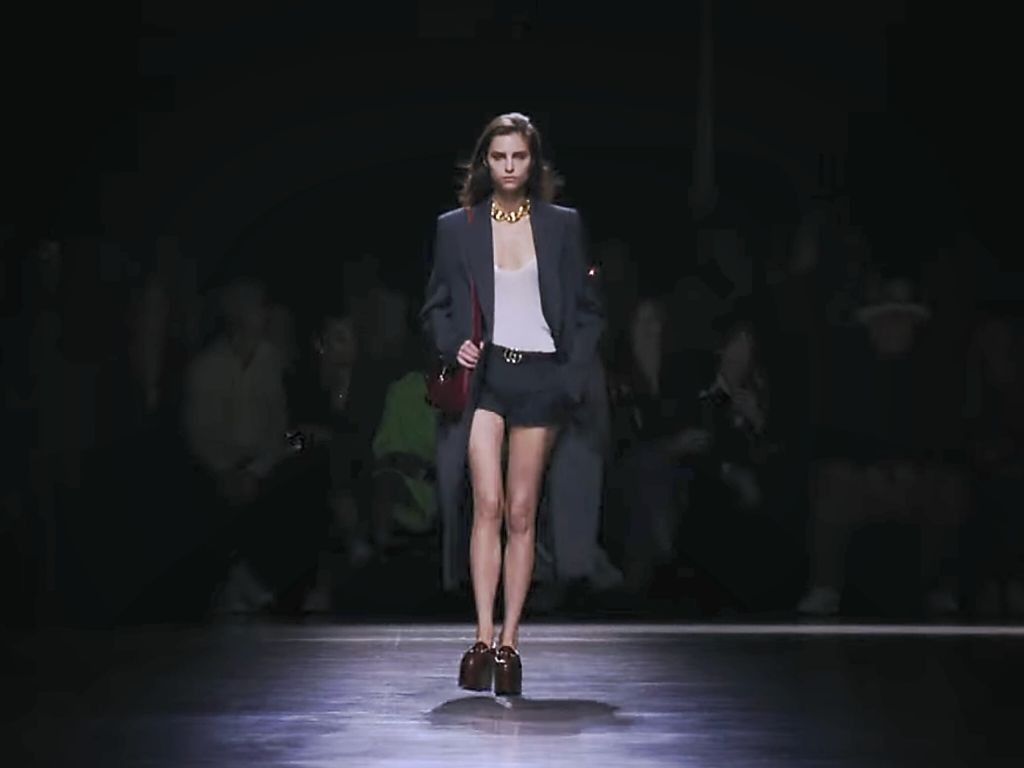
It was the second let down in just three days of Milan fashion week. Sabato de Sarno was the second new creative director debuting at a not-so-new house. A day earlier, Peter Hawkings showed his first Tom Ford collection, and that had the high consistent with unleavened bread. Now, it is Gucci’s turn to show off the brand’s fifth designer after Tom Ford left the house in 2004. When The New York Times’ Vanessa Friedman recently asked Mr de Sarno what was “going to surprise people about [his] Gucci”, Alessandro Michele’s successor said: “I think the first thing is I’m more real. I don’t want to build another world,” which stood out for its startling lack of zest. As it turned out, he sure did not.
The broadcast was supposed to have started at 9pm (our time), but, as is usual with most livestreams, it did not. When it did come on about 10 minutes later, the screen showed guests arriving and mingling, all bathed in red light—scoring a patina that, in other times and in other cultures, is associated with pleasure quarters. From the NYT interview, we learned that Gucci has “a brand new colour: red” (more on that later). Despite the indistinct bodies seen in the red glow, it could be discerned that very few were togged in vintage-y, Alessandro Michele-era threads. Unsure of what to expect or how to align themselves with a brand in transition, most were neutrally attired. These could have been guests attending a Benetton show. Was it prelude to the “extreme poverty of ideas”, as one disappointed Gucci fan texted us moments after the show?


Whatever we think of Alessandro Michele (regular readers of SOTD would know), we could never say he was boring. Mr de Sarno’s ensembles were, conversely, characterised by something inert. The realness that he said he embodies translated into clothes that had no reason to exist on a runway: that hoodie, that denim trucker, those lingerie-dresses, hot pants, baggy jeans, A-line skirts. We kept seeing Sisley, with Chiara Ferragni thrown in for good measure. And more than some snatches of Valentino (where Mr de Sarno had worked for about 14 years)—the tank-dresses, the slouchy shirts, the graphic embellishments. Oh, the “new” red, called rosso ancora (Italian for ‘red again’), more ox-blood than chilli. Coincidence or inspired? There were also the American-style itsy-bitsy bra tops (or the truncated leather singlet). Even when they were adorned, they were shorn of the refinement one would reasonably expect from a Valentino alum. It was deeply dismal to think that Mr de Sarno was trying to capture the much-dreaded zeitgeist, which was really another weave for idleness of design.
Sometime, the presence of other brands was evoked. Those ultra-short shorts—Miu Miu, no? Or the oversized wing collar of one jacket—not too Louis Vuitton? Despite the flourishes, the collection bordered on the clearly wearable, with unimaginative sexiness as counterpoint, geeky sportiness for good measure, and platform horsebit loafers the footwear to covet. The exertion of aesthetical power came to a screeching halt in the last two little black dresses. Where they designed by assistants of assistant junior designers? And how groundbreaking was it to team a short dress with white sneakers? In this generation of kicks-loving consumers, a pair with LBDs is a style hack that many still need or benefit from? It is hard to say if Gucci really desires a 360-degree turn from its recent past. Did they not learn anything from Frida Giannini?
Screen shot: Gucci/YouTube. Photos: Gucci
 Style on the Dot