Our island’s oldest multi-label fashion store is finally in the heart of Orchard Road. It is a welcome respite from the many over-busy luxury stores on retail’s main drag

An unidentified, slanted entrance to the new Club 21 store
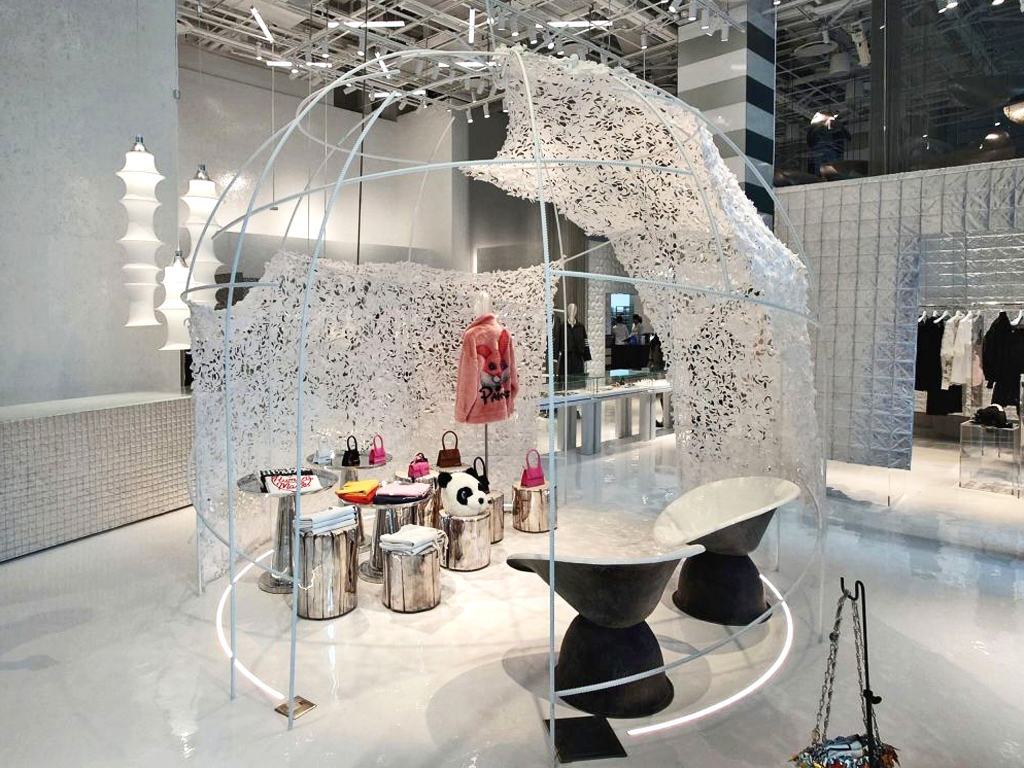
A merchandise installation within a globular frame to greet shoppers
For close to thirty years, Club 21, the multiple-label store, not the retail company, has stayed put in the Four Seasons Hotel. Most millennial shoppers—and younger—only know this bifurcated space that is the men’s store on one side and the women’s on the other. In recent years, mini Club 21 boutiques have occupied units vacated by other brands in The Shopping Gallery at the more accessible voco Orchard (the former Hilton Hotel), but the stores have remained in that (upper) part of Orchard Road, bordered by Cuscaden Road and Orchard Boulevard. They sit there, in their own retail oasis of atas exclusivity, a tabernacle of the swanky, cared for by cold custodians, away from the hordes. Until now.
It was hailed as good news when it was announced last July that Club 21’s latest store would be situated in the middle of Orchard Road, specifically on Bideford Road, at the spot where the Thong Sia (distributor of Seiko watches) building once quietly stood. The choice of Bideford Road, named after the port town in Devon, south-west England, perhaps continues with Club 21’s preference of not wanting to be on Orchard Road itself. The site of the store maintains another locational tradition: ensconced in hotels, now at the COMO Metropolitan, only the second in Asia after Bangkok. The hotel is part of the COMO Orchard complex described as an “immersive experience building”, owned by Club 21’s founder Christina Ong, the almost deific retail and hospitality doyenne behind the COMO Group.

While not a large space, the new Club 21 feels spacious

Full-length windows bring in the verdant street-side into the largely hard-edged space—a first for a Club 21 store here
From Orchard Road, it is about 200 metres away or eight minutes by foot from the Apple store. If you Grabbed there, you could actually be dropped off very near the entrance of Club 21. At street level, Como Orchard does not stand out. There is no signage to tell you what building or address you have arrived at. The way into Club 21 is through an entrance further down Bideford Road, through glass doors set within thick, red-tiled frame that punctuates the glass façade. As it stands on a slight slope, the entrance does not appear level, and is, in fact, asymmetrical, skewed. Again, there is nothing upfront that announces the name of the entity or the nature of its business. Its secret-address-in-the-open has a neo-Japanese trade identification convention about it. We can’t say that (and the fact that it’s street-fronting) is not the appeal. If you need to give directional instructions, just say: Find the red doorway.
Inside, we sensed that a clothier to the cognoscenti immediately greeted us. And greeted, they did—a chorus of hellos. Before we could breathe in the smell of newness, and let it kick in, a friendly chap approached us, and said, with appreciable eagerness, “may I show you around?”. An unavoidable once-over suggested that the two-floor store is not nearly as large as the original at the Four Seasons Hotel (both sides combined). It would not be hard to navigate the space. We did not, therefore, need a guided tour, but it was hard to turn away amiability, so we accepted the fellow’s nice offer. Club 21 is not exactly known for its personable service or its infectious warmth. This antipodal personality of the new space and the staffers, and the prospect of joyous discovery were to be enjoyed.
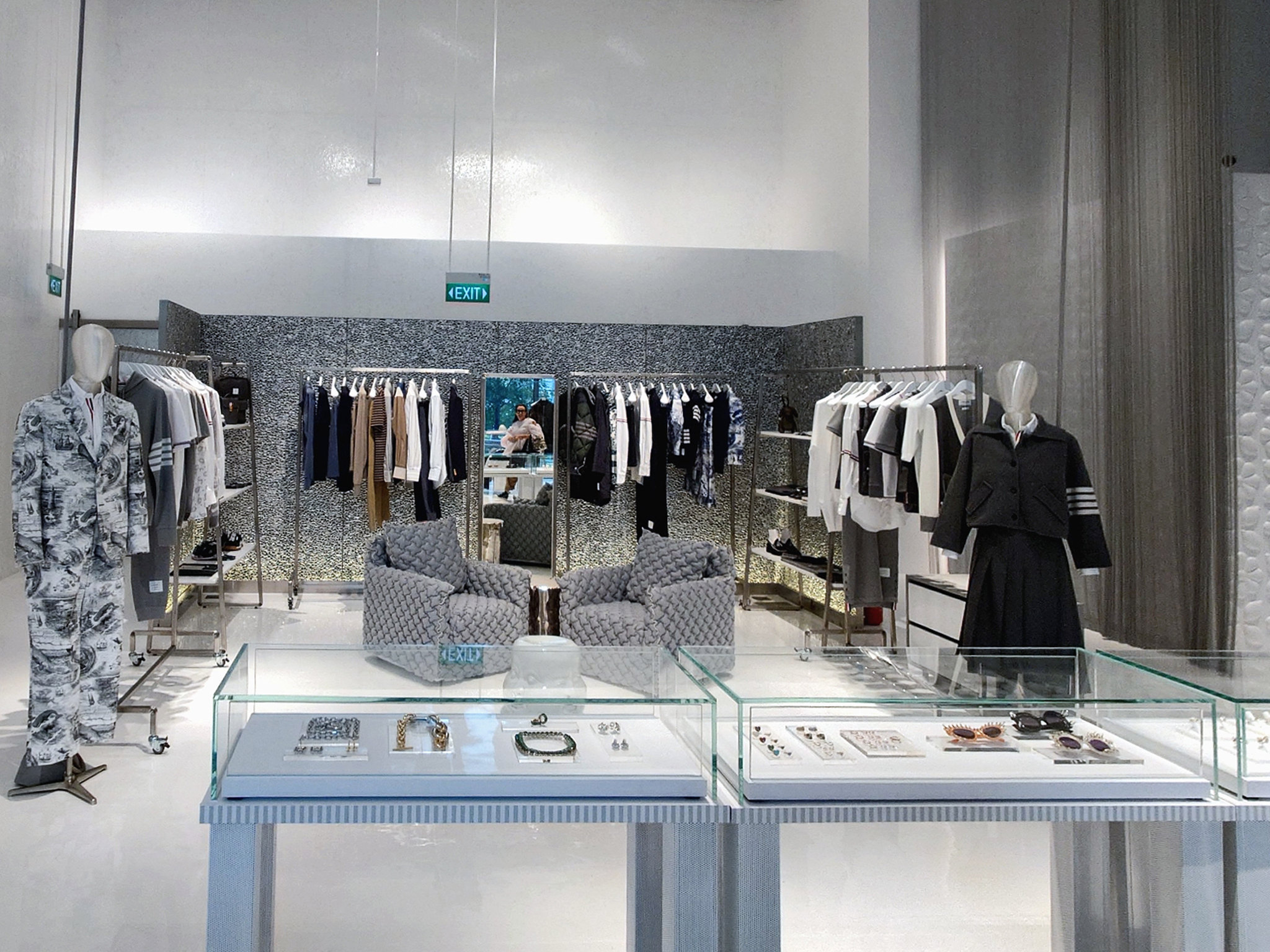
Greys of textural variation help the space stay away from the monotone

Upstairs, the warmth of the lighting is dialed up a notch, as well as the industrial coldness
We were told there are two floors to the boutique. Our guide described the space as “industrial”, which is probably to say that it is not plushy-cozy. Designed by Paola Navone of the Milan-based Otto Studio, a regular collaborator with Christina Ong for her COMO hotels and resorts, including the Castello del Nero in Tuscany and the COMO Metropolitan above the store, Club 21 now is a paradigm of intentionally disorganised swish. The space planning is almost bazaar-like, with brands calling out from within sometimes irregular demarcations. Regular shoppers at Dover Street Market’s global locations—including the one here, DSMS—would be familiar with the non-linear, non-grid, nearly maze-like spatial composite. Screens, curtains and dividers—a melange of what could be found materials and objects, such as the hollowed bricks or quilting that looks like it was repurposed from Mylar blankets—mark off the space with no discernible alignment or pairing. In sum, the interweave of materials isn’t what has not been witness elsewhere, such as the IT stores in Hong Kong.
The merchandise zoning is non-binary, since most brands stock menswear and womenswear, or unisex lines. The collections are organised by brands—some of the names lit across electronic boards. When we entered, we saw Simone Rocha on the right of the entrance, an unexpected choice and placement. As we explored, guide in tow, we saw more European brands—Ami, (the Berlin bag brand) Innerraum, Jacquemus, Jil Sander, Marine Serre, a few that we can now recall. We did not run through the brand list, but we spotted only one Korea label, Post-Archive Faction, and only two Japanese, Doublet and Human Made. Conspicuously missing are the brands associated with Club 21, such as Comme des Garçons, Junya Watanabe, Sacai, and Undercover. And, unsurprisingly, there are no Singaporean brands, not even hypebeast fave SBTG or Youths in Balaclava. It is tempting to cast the merchandising as street-bent, but it is no doubt sifted through to appeal to increasingly super-casually-dressed customers, even those seeking leisure pursuits in premium Orchard Road.

Concrete floors to better underscore the design’s calculated edginess
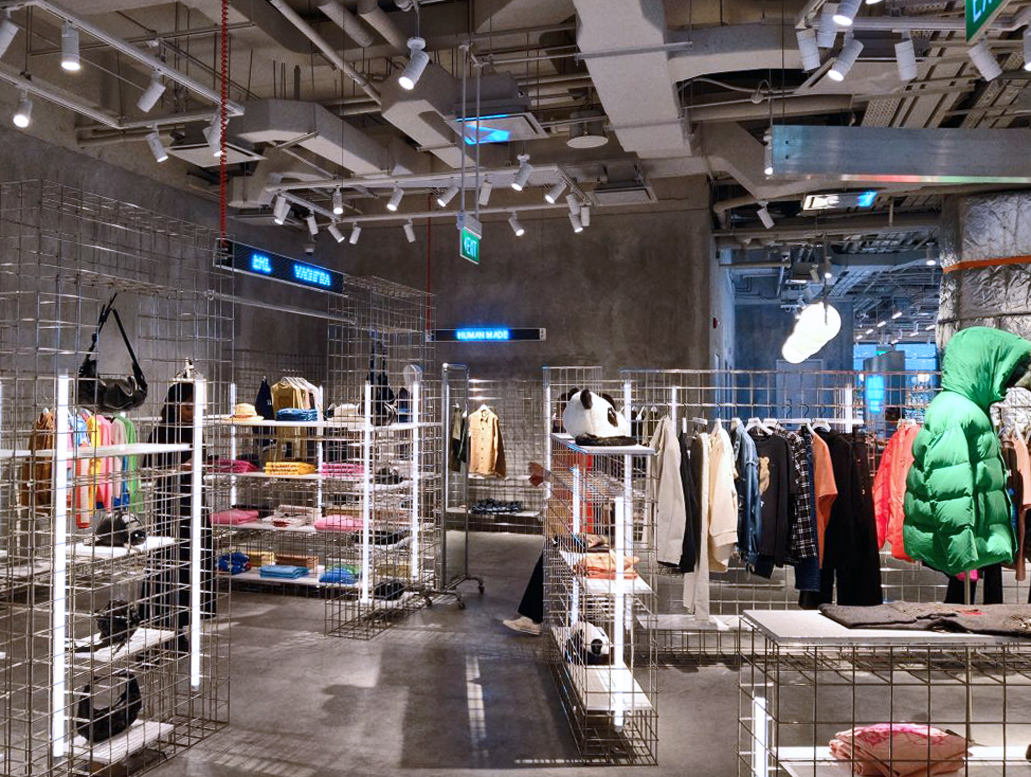
Metal-mesh frames, the obligatory touch to evoke street cred
On the floor above, the space is a tad different—warmer, but attic-like, and, similarly, not conceived for lingering. As the lift that serves both levels were still not ready for use, our good guide had to lead us up here by our first exiting the store to go to the entrance where one would have alighted if one came by car. We walked in, through the cafe by patissier Cedric Grolet, to use another elevator. The doors opened right into the second floor of Club 21, now even more DSMS-like. This is more modification than revolution, but it is okay. The young shoppers that the store appears to want to attract would likely not notice the TikTok-era disarrangement, or the metal grilles used so abundantly (and the strange pillar wrappings that look like padding used to line a lift to protect its walls against rough movers or deliverymen) as they make a beeline for the Jacquemus T-shirts with the crossed and splayed, logo-ed ribbons, stitched to the right side of the chest.
There has not been a new Club 21 store here since 1994 (excluding the small set-ups in The Shoppes at Marina Bay Sands), when the flagship at the Four Seasons Hotel opened. Even with a better location this time, it is hard to say with certainty that the brand has pulled off a retail environment that heightens the lure of the merchandise inside. It is all attractive, but with a discernibly premeditated theatricality. The merchandise and the setting in which they are placed to entice are a synthesis of the street-inspired and the not. But the dialogue between high and low are no longer voluble, more so in the low-energy atmosphere that has been characteristic of Club 21. As this was the first day it opened, the store that CNA recently called—somewhat unenthusiastically—“haven for fashion enthusiasts” was, as expected, slow on foot traffic. We asked our guide if it had been busy, and he said that it had mostly been visited by “VIPs, no so much the general public”. Oh—we’re sure—just not yet: Jackson Wang is expected to be partying there tomorrow.
Photos: Chin Boh Kay
 Style on the Dot