Who is Ong Beng Seng, the “media-shy” billionaire now in the news, and also a keen fashion retailer?
It has been the talk of the town, to put it mildly. We woke up this morning to more than two dozen WhatsApp messages with links to news reports of the “arrest” of hotel and property tycoon Ong Beng Seng (王明星, wang mingxing) by the Corrupt Practices Investigation Bureau (CPIB) and that he is, as The Straits Times wrote, “cooperating with the anti-graft body to provide information in relation to his interactions with Transport Minister S. Iswaran”, who was earlier told by the prime minister to take indefinite “leave of absence” while he, too, was the subject of an investigation by the CPIB, described by Bloomberg as “Singapore’s most serious political graft probe since the 1980s.” It isn’t immediately clear why Mr Ong, husband of Club 21’s Christina Ong (née Fu) and known mostly by his full initials OBS, is embroiled in the case involving Mr Iswaran, a 26-year veteran in politics. The PM’s office did not state what the investigation was about.
Ong Beng Seng was born in 1946 in Perak, West Malaysia (some reports* state Sabah in the East)—specifically Teluk Anson, as it was known during the British protectorate years (now it is identified on the map as Teluk Intan or Diamond Bay in Malay) to Ong Teik Bee and wife Tan Guan Kheng. The Business Times and other news outlets described the parents as “wealthy”, without identifying their source of wealth or what line of work they were in. There are four other boys in the family; Mr Ong is the second eldest child. Little is known about his childhood in Teluk Anson. At age four, he moved with his family to Singapore, then still a British Crown colony. Where they lived and what contributed to the family’s income escaped being told (Mr Ong, has retained his Malaysian passport). In time, the young boy attended Anglo-Chinese School and was, according to a 1992 editorial in The Business Times, “a champion sprinter and long jumper”, which may explain Mr Ong’s ectomorphic frame, even later in life. Some time in the ’60s, he left for Britain to further his studies and subsequently received a degree in insurance.
After graduating, he reportedly delved into underwriting and broking, working in London, Europe, and Southeast Asia before returning home in 1972 (or thereabouts**), where he remained in the insurance business, specifically shipping insurance, through which “he earned his first fortune”, according to CNA. Three years later, he joined his father-in-law Peter Fu Yun Siak’s (符运锡) firm Kuo International, which, in the beginning, traded in timber, wax, and tin. Later, Mr Fu turned to the trading of oil. In a 1989 report, ST wrote that Mr Ong, “in the local oil world, is something of a sheikh.” With Kuo International, he ran “the largest oil trading operation in the world, with an annual turnover of over US$1 billion (then, S$1.94 billion). Other publications in the West, such as the Independent, would later describe him as “Southeast Asia’s shrewdest businessman”.
Mr Ong, ‘in the local oil world, is something of a sheikh’
It was not until 1972 that Christina Fu (it appears she does not have a Chinese name), daughter of Peter Fu Yun Siak, was linked to Ong Beng Seng. Their romance was not the stuff of legends, but in the annals of Singapore‘s business sector, fortunes of the couple are very much noted, and their clout in the industry admired. It is not clear how they met, where or when. Married for 51 years, the pair in business became so formidable that Forbes considered them “one of Singapore’s most influential couples”, with an estimated US$1.7-billion net worth as at August 2022. They were married in 1972, the year Mrs Ong, as she is known to her staffers and associates, started Club 21 at Tanglin Shopping Centre, which, when it opened in 1961, was marketed as a luxury mall (Dick Lee’s mother’s boutique, Midteen, through which he embarked in fashion, was also situated here). Some reports speculated that the couple became acquainted after he joined Kuo International, but that was in 1975. They have two children, a daughter Melissa and an adopted son Jonathan.
Although Christina Ong is much associated with the retail behemoth Club 21, the business, in fact, started rather modestly. It was a small (some described it as “tiny”) tailoring outfit. The other mall on the yet-to-be shopping belt on Orchard Road that opened around the same time was Specialist Centre (it was torn down in 2008). Interestingly, a 1971 editorial in the now-defunct daily New Nation wondered: “Can Singapore accommodate the coming shop glut?” It was said that Mr Ong had given Club 21 as a betrothal gift to his wife—the surplus of retail space possibly opportune. Yet, other stories claimed that it was because a hired tailor did not show up that Mr Ong then asked his wife to do something with the space. Whether he had planned to let her turn it into a retail giant, it wasn’t known (Club 21 was not incorporated as a private limited company until 1976). In the beginning, apart from tailoring services, Club 21 also sold ready-to-wear labels—mainly British, such as Ossie Clark and Jeff Banks (also co-founder of the British label Warehouse), as both owners were known Anglophiles. It is not certain how involved Mr Ong was in Club 21 but, back in the day, Mrs Ong was often seen in the shop, serving customers.
Although Club 21 was managed by his wife, Mr Ong was not entirely kept away from the retail business. Even when he was nearly always referred to as a “hotel and property tycoon”, he had, through his acclaimed Hotel Properties Limited (HPL—now, as Reuters reported, a US$1.5 billion company) a hand in retail too. Most notable was Blue Moon in 1991, the earliest “lifestyle store” here, situated in HPL House on Cuscaden Road, just below Hard Rock Café, another HPL business. Blue Moon brought together fashion, accessories, gifts, greeting cards, pop and movie posters, and even music CDs in a sleek, semi-futuristic space designed by the renowned Singapore-based, American architect Ed Poole. And it was HPL that also introduced to our island expensive ice creams in the form of Häagen-Dazs one-pint tubs, via their division Pinedale Trading, which owned the brand franchise for Singapore and Hong Kong. At the same time of the Blue Moon opening, there was even a Scoops café that offered sundaes made with Häagen-Dazs ice cream, as well as ice cream cakes, uncommon at the time. The café even had its own newsletter, also called Scoops.
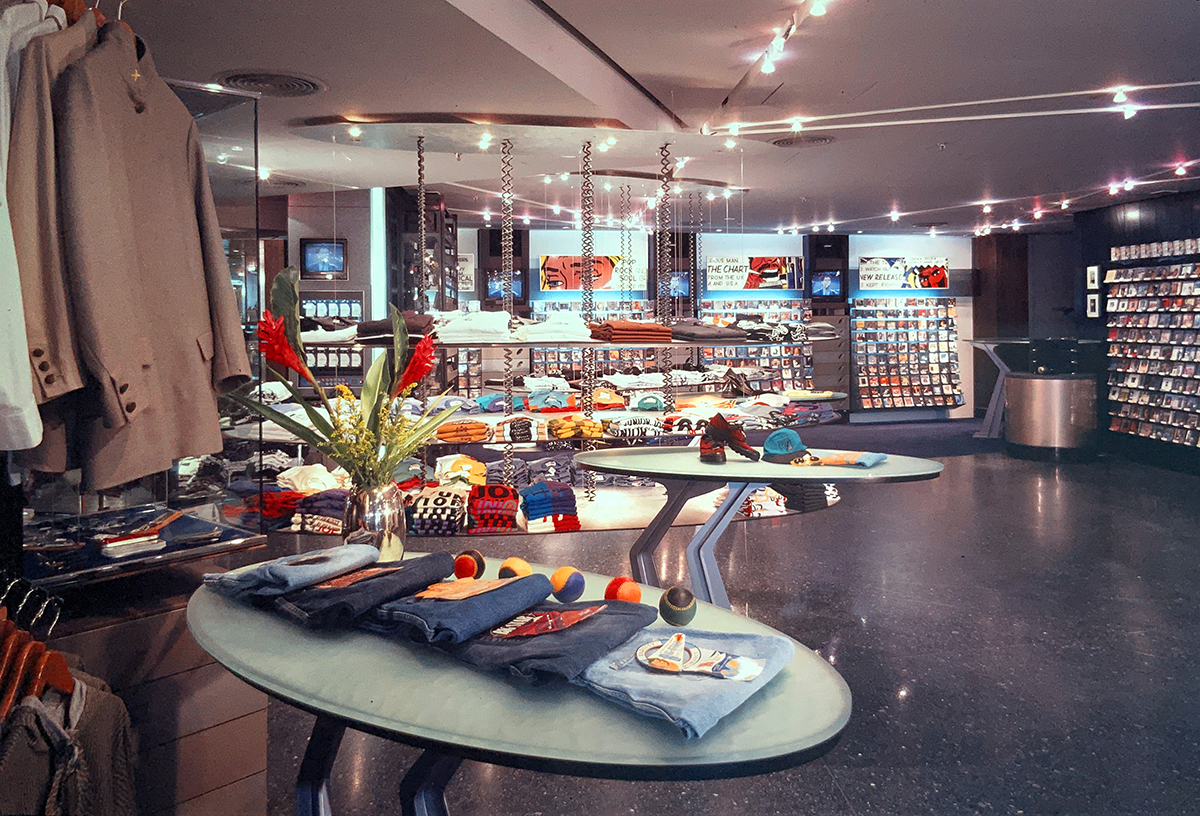
The now-mostly-forgotten Blue Moon, an HPL retail project. Photo: Poole Associates
Blue Moon pioneered the retailing of hipness in the early ’90s when shopping was talked of in terms of how experiential they were, or should be. Despite the unique positioning of the store, it was closed in 1995 (some observers thought they were ahead of their time). It made way for Blackjack a year later (Scoops became Blackjack Café). Also a multi-label store but kept strictly to fashion products, Blackjack amplified the former’s hipster cred, but was fine-tuned for a new breed of shoppers snapping up the minimalism peddled by Helmut Lang and, following closely, Calvin Klein. In 1998, the store relocated to the neighbouring, HPL-owned Forum the Shopping Gallery. It shuttered in 2011, only to be resurrected last year as a casual clothing label under Club 21. Oftentimes, it was not easy to discern which entity was behind what. Even Mr Ong was not always aware. One marketing professional remembered an incident in Bangkok’s Paragon Mall in the early 2010s and told SOTD: “I was walking into the complex from the exit of the Siam BTS station,” he said, “and soon noticed the Ongs ahead of me. I heard OBS asking his wife rather loudly, while pointing to the Dolce & Gabbana store to his left, ‘Dear, is that ours?’ Mrs Ong did not say a word. She shook her head, and beckoned her husband to follow her as she headed to the Club 21 accessory store to her right, next to the elevators.”
Mr Ong always had fashion retailing in his blood even when hotel ownership was more appealing to him. He was not content, however, with a smallish lifestyle store. In 1995, Bloomberg reported that HPL, through a newly-formed licencing alliance HPL-21 (guesses not required for how that came about), paired with Donna Karan to expand the brand’s presence in Asia, with a US$21 million investment in the Donna Karan Japan, a wholly-owned division of the designer’s company. The agreement furnished HPL-21 with exclusive retail rights for Donna Karan New York, DKNY, DKNY Jeans, and DKNY Active. Ms Karan herself was said to be a “good friend” of Christina Ong. The designer was known to take holidays in Mrs Ong-owned, Como-branded holiday resorts in Bali, even reportedly attending yoga sessions with the clothier-cum-hotelier. In 1998, news emerged that HPL-21 was “restructuring” their part in Donna Karan Japan. WWD reported that HPL-21 “owns 52.5 percent” in the subsidiary. It later emerged that “HPL sold all its shares in Donna Karan Japan”, as per the Independent. In 2001, LVMH aquired the American label, surprising the industry. Fourteen years later, Donna Karan announced that she was stepping down from the company she founded, and a year after that, LVMH sold the brand.
Ong Beng Seng, by most accounts, is an affable, even if somewhat brash, character. In his younger days, he, like many men, loved the nightlife, but unlike others, he would get into the business of enhancing the night entertainment scene here, even before the ground-shaking F1 Night races, such as bringing to our shores (and in the region) Hard Rock Café. In Hong Kong’s Tsim Sha Tsui, he owned Hot Gossip (1985—1992), a popular night spot among the city’s stars, such as regular Michael Wong, who naturally attracted hordes of female patrons. Despite his tough businessman and party-hard image, Mr Ong has been often described favourably. A former Hard Rock Café general manager, Albert Toh told ST in 2007 that Mr Ong “can relate to people from all walks of life, and put them at ease quickly.” Those who previously worked with him spoke of his caring manner in the office: “He took pains to know the junior staff,” one said. ”He would chat with all the cleaners and pantry girls at the Hilton (now voco Orchard), asking about their health or their kids—that sort of thing. He was always cheerful.”
*Even among SPH publications, there have been different accounts of where Mr Ong originally came from
**Dates vary as accounts, too, vary
Update (3 October 2024, 7.30pm): As the biggest news of the year unfolds, Ong Beng Seng is now scheduled to be charged tomorrow in relations to the S Iswaran case. His links with Mr Iswaran, it appears, has complicated things for one of Singapore’s most noted, but intensely private businessmen. This past August, Mr Ong’s Hotel Properties Limited won approval from the government to redevelop a slew of prominent Orchard-area properties that the company owns. It is not certain how his charges in court would impact HPL’s influential plans for the city’s most-known street. Or whether there would be a spillover effect on his wife Christina Ong’s Como Resorts and Club 21 businesses.
Illustration: Just So
 Style on the Dot