Ludovic de Saint Sernin, like so many designer these days, wants to blur the lines between womenswear and menswear. Unlike few others, he practises what he preaches

Ludovic de Saint Sernin as seen at the end of his recent Paris show. Illustration: Just So
By Ray Zhang
Menswear, as we know, is going where few men have ventured. But it seems that when you put them out, guys would want them, such as skirts. One of the luxury brands that showed considerable number of skirts these past years has been Louis Vuitton, but the house does not release figures, so we do not know how well they sell them. While designers have for a while taken ideas from womenswear, they have not really picked from women’s underclothes, until now. At the recent show for his eponymous label, Ludovic de Saint Sernin took the traditional runway bow at the end of his spring/summer 2024 show wearing a diamond-shaped fabric round his torso that in ancient times in China would be known as the 肚兜 (dudou) or tummy wrap, which, to me and countless other Asians—I’m sure—is 内衣 (neiyi) or inner garment.
I think, to Mr de Saint Sernin, what he wore was just a sexy, flimsy top, a squarish fabric that was held up as a rhombus, with the top end secured around the neck at the sternum, with two other corners attached to a cord, and tied at the back so that the equilateral cloth wraps the torso. The last right-angled end was left unfastened, pointing to his crotch. I do not know what he saw in the mirror before he stepped out, but it appeared to me that he had on a simple dudou. In China, this style of underwear is mostly a relic of the past. In the beginning, they were generally known as 抹胸 (moxiong, literally obscuring the chest), a piece of fabric, mostly four-sided, tied closely to the woman’s body. It is unclear exactly when this form of undergarment was adopted, but in all likelihood, they were worn really early to keep the abdomen warm.
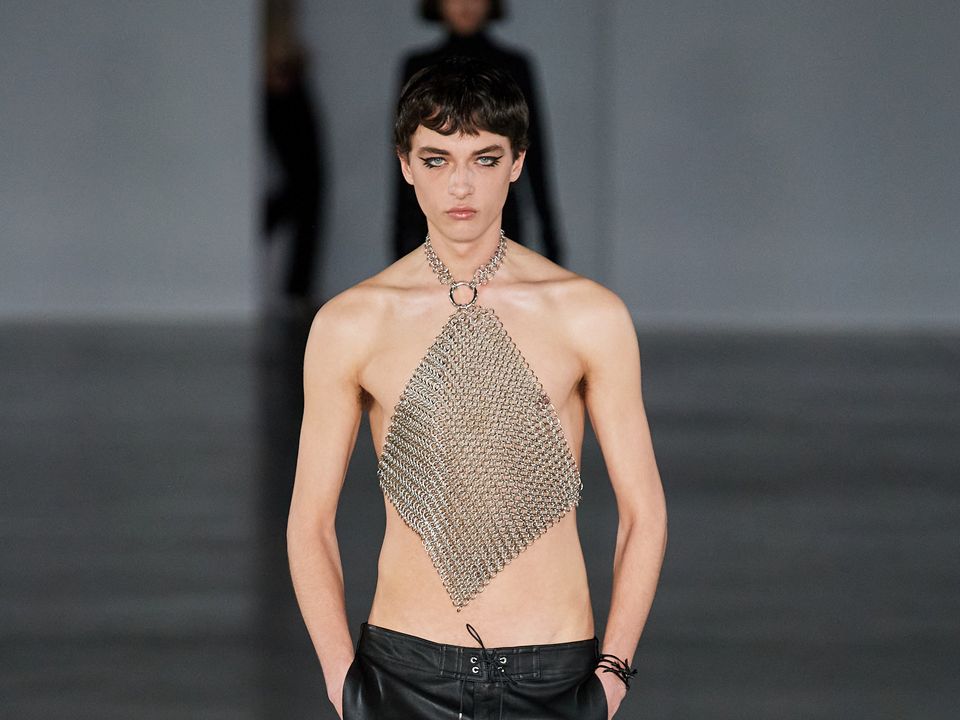
Ludovic de Saint Sernin autumn/winter 2022. Photo: gorunway.com
The dudou in the diamond shape and secured to the body the way Mr de Saint Sernin did, is commonly associated with the version adopted in 清代 (qingdai) or the Qing dynasty. I remember seeing them worn by some characters on TV, in the period Taiwanese movies that my mother used to watch, when seductresses would, at some point, strip or have their clothes ripped to reveal a red, embroidered silk dudou (inexplicably it was nearly always red). While they were considered underwear, women were not the only ones who wore them. In fact, children were kitted in them too (in rural China, such clothing for toddlers are still used). The Chinese folk hero/child-god Nezha (as depicted in 西游记 [xiyouji] or The Journey to the West) was often illustrated wearing a kid’s dudou. But, Ludovic de Saint Sernin is no child.
For now, let’s just call what Mr de Saint Sernin had on a dudou. The top he wore, however, was not entirely new or unusual if we look at his recent work. Variations of that chest wear has appeared before, including one, I distinctly remember—in chainmail—from the autumn/winter 2022 collection. Did it look more masculine then? Was it a butch bib? Did it constitute a garment? Perhaps these aren’t the questions to ask since the aesthetical difference between his menswear and womenswear was rather blurred. The latest co-ed collection he showed was called Lust, which may explain Mr de Saint Sernin’s choice of top or the many others in the collection that were basically pieces of cloths, too. Seriously, I do not know if the title meant great sexual appetite or ardent enthusiasm in, perhaps, tops that, if aren’t underwear, are very short aprons.
 Style on the Dot