人生不需要每一次都赢 or In Life, One Does Not Need to Win Every Time is a photobook with fitness tips, and more. Strictly for undemanding fans

“Overnight Internet sensation” Tan Chuan Do’s first book
What category does a book fall under when it is part self-conscious pictorialism, part superficial autobiography, part self-promotion, part motivational essay, part fitness advice, part basic nutritional pointer, part healthy-living guide? Frankly, we don’t know. But Singaporean photographer and Instagram star Tan Chuando’s (陈传多) writing debut, In Life, One Does Not Need to Win Every Time, is a heterogeneous medley that could be charming if you were not seeking reading material that engages and stimulates the mind. Or, if photographs of Mr Tan’s bare, chiselled chest and rippled abs are satisfying—or gratifying—enough. It is an airy rumination on the past 57 years of his life, excluding rather noticeably his childhood, but do not expect poetic reflections that might reveal the brain behind the brawn.
Published in Taiwan in traditional Chinese characters, with the classic text that reads top to bottom, and right to left, the book could be the feelings of a teen star expressed to his fans who are his contemporaries, except that Tan Chuan Do is now edging inexorably towards 60. In the introductory chapter, he describes himself in rather boyish voice. “我的个性非常害羞, I am very shy,” he writes. “当我得知自己受到很多人关注和喜爱时,心里其实很惶恐,when I learned that many people have paid attention to me and liked me (the media here described what he experienced as “overnight Internet sensation”), my heart was, in fact, terrified.” Despite having been a model (the first job that he mentions), Mr Tan makes himself, as he is inclined to, comes across as an incredibly bashful person, and it is this seeming diffidence that characterised the timid writing. This is not a punchy, life-changing piece of work for the reader. It may suit those who enjoy pretty pictures with caption-style text that could be inspirational lines for Chinese Hallmark cards.
This is not a punchy, life-changing piece of work for the reader. It may suit those who enjoy pretty pictures with caption-style text that could be inspirational lines for Chinese Hallmark cards
It is unsurprising that Mr Tan chose to pen his first book in Chinese. In interviews with the English-language press here, he often apologises for his command of the language that is shy of proficiency. He went to Nanyang Primary School (南洋小学), which began in 1917 as the primary institution of Nanyang Girls’ School, and, until 1983 when it started English-stream classes, was largely known as a “华校 (huaxiao)” or Chinese school. At the time that Mr Tan attended Nanyang Primary, Mandarin was likely still the main language of instruction. He continued with his secondary education at Pei Dao Secondary School (培道中学, now Punggol Secondary School), another Chinese school in the institution’s early years. Final schooling was at Nanyang Academy of Fine Arts, where he gained a diploma in graphic design and photography. There is only scant mention of his school days in his book. It is not known if the academic trajectory via schools associated with the Chinese intelligentsia, therefore, made him more conversant in Mandarin, even when he would subsequently travel the world modelling and spend considerable amount of time in New York to establish his modelling career and, later, profession as a fashion photographer.
So much more comfortable he is in speaking Chinese that when he accepted his first acting role, it was for the 2021 Chinese-language film 今宵多珍重 (jin xiao duo zhen zhong) or Precious is the Night, a Singapore/Taiwan joint production, which received only a short mention in the book. Despite his self-proclaim limitations in English, he did once parallel his much-admired youthful looks to the literary character Dorian Gray. In an interview with Channel News Asia (CNA) last January, he said: “They are giving me this mascot of forever young, literally. It’s like I am the Dorian Gray in real life.” Presently, he makes no such mention. The comparison was fascinating and aroused the question: Has he ever read Oscar Wilde’s only novel, even partially? Unfortunately, the CNA reporter did not question him further. Did he identify with what Lord Henry Wotton said of Mr Gray: “All the candour of youth was there, as well as all youth’s passionate purity. One felt that he had kept himself unspotted from the world.” Would Tan Chuando, like Dorian Gray, trade his soul for eternal youth to allow one of his photographic portraits to age instead? Or, if he was, in fact, more like Lord Wotton, who believed that “an artist should create beautiful things, but should put nothing of his own life into them. We live in an age when men treat art as if it were meant to be a form of autobiography. We have lost the abstract sense of beauty”?

CD’s CD 远走高飞 from 1993
Much of the information about himself that he provides in the book is rather sketchy. He does not go into details or provide dates, nor background. Every chapter has the bulk of a preface. In fact, some chapters merely fill two grand pages. Mr Tan mentioned that he was a recording artist in his early twenties (which would be in the early 1990s). Then, he was known as 陈宇飞 (Chen Yufei). He told 8 Days in 2017 that Chen Yufei was his “stage name” and his given name is 陈传多 (Chen Chuanduo). It is homophonic to his Anglicised Chinese name, usually abbreviated to CD, which was—and still is—used by industry folks. When he launched his one and only Mandopop album, 1993’s 远走高飞 (yuanzhou gaofei) or Escape to Faraway Places, the name that appeared on the cover of the album—then CDs and cassette tapes—was 陈宇飞. In the book, he made no reference to the use of this name during this part of his life.
He attributed his recording career—although an extremely brief one—to the xingyao (新谣, Singapore songs) composer/producer Chen Jiaming (陈佳明). He also pointed out that Mavis Hee (许美静, Xu Meijing) was also signed to the same recording company. At that time, due to a photograph published in the press that featured the Taiwanese songstress Tracy Huang (黄莺莺), flanked by Tan Chuando and the model/Channel [V] video-jockey Rick Tan (陈志成, Chen Zhicheng), there was chatter in fashion circles that Ms Huang was grooming CD to be a singer (both men are unrelated), to the dismay of the latter. As it turned out, singing was not the budding photographer’s thing. At the time, it was thought that his singing was lacklustre, vocal tones wanting, and timbre vague. Mr Tan writes in the book that singing did not suit him as he was too shy. He added: “我还是比较喜欢当模特儿,因为走伸展台不必开口, I still liked modelling more because when I walked onto the stage, I didn’t have to open my mouth.”
He does not go into details or provide dates, nor background. Every chapter has the bulk of a preface. In fact, some chapters merely fill two grand pages
He shares little about his experiences as a fashion photographer, only that he is very hardworking, to the point that he once went on for three consecutive days with no sleep; he did not say whether he was photographing or Photoshopping, or occupied with both. He did not address the charges that he is not an easy person to work with, and can be demanding, or uncompromising. He only mentioned “一些抹黑我的批评” or some criticism that blackened his reputation, without revealing what unpleasantries were uttered. But he did state that, as a Pisces, he is very strong. When he is unhappy, he won’t show it outwardly, he won’t stand up to defend himself or to dispute the other party. Even when he is wronged, he’d still “不争不吵”, not quarrel because “人生很短,凡事不需要太过执着,也不需要每一次都赢”, life is short, you don’t need to cling to everything (or be persistent), and you don’t need to win every time.
When it comes to his favourite activities—body-building and swimming—he offered no persuasive recommendation that would get anyone immediately fall in love with the chess press or go straight to the pool. He reveals that he grew up among male family members who were bodybuilders, including his father and his dad’s younger brother who was a body-building champion. His mother would bring him to the gym to watch his father work the weights. He was quickly influenced and took up the sport when very young (he offered no age). To him, body-building is the secret to his youthful looks, his “保鲜劑 or preservative”, and through working out, his body would not age. He then went on to explain—with no resonance of the gym—why he thinks working out has made him look younger than he really is. This whole chapter, one of the longest, is no pep talk, and gets tedious as it gets on, with a parting shot that is hardly impassioned or inspiring: “健身是我人生中的一部分,我会一直继续锻炼下去, fitness is part of my life and I will continue to train.” When it comes to his love for swimming, the introductory line of the chapter is hardly a hook: ”游泳对我来说是一件非常愉快的事, swimming, to me, is a very happy thing”.
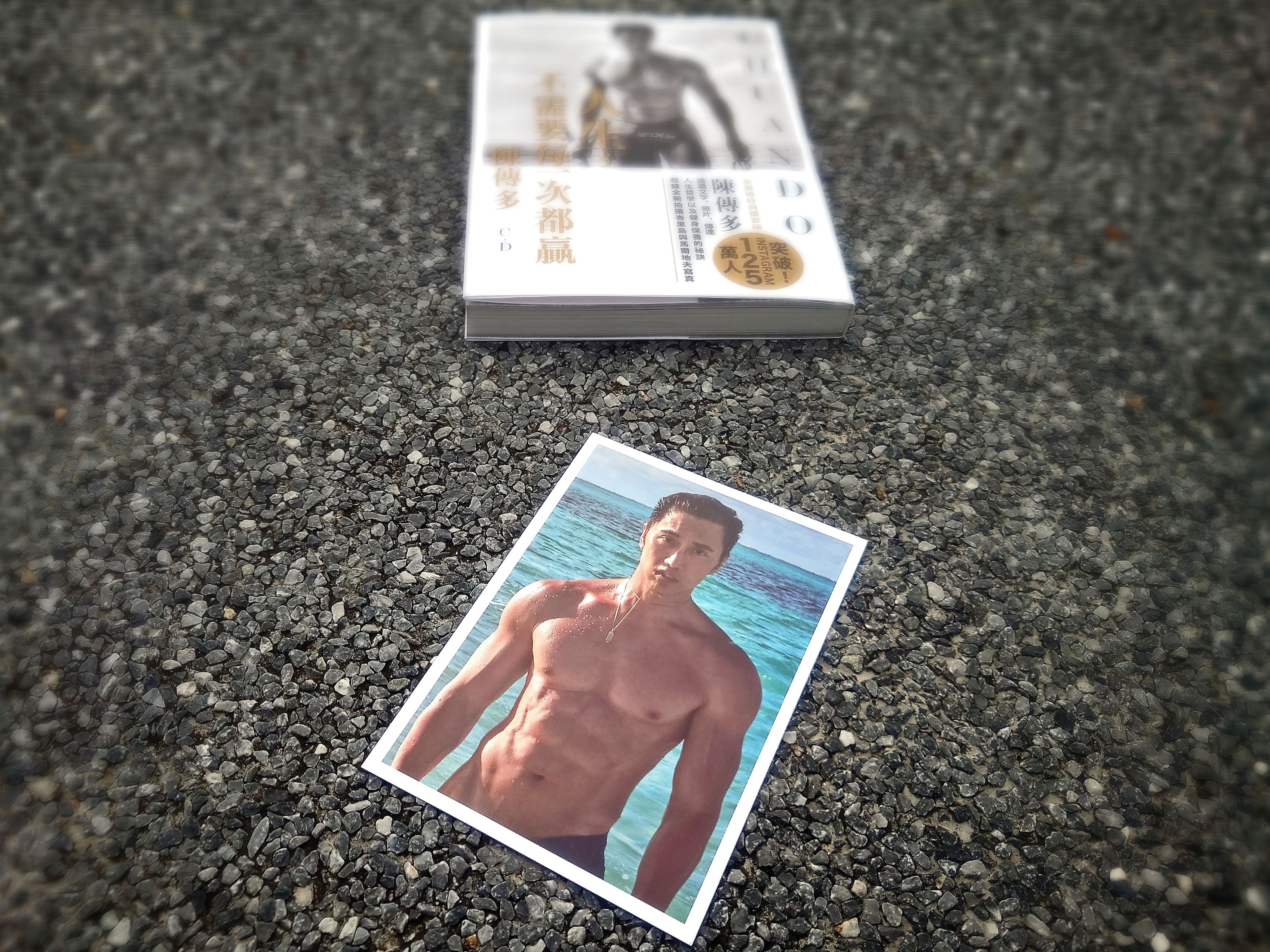
Each book comes with a postcard-sized bookmark that can be framed for the nightstand
Just as there are those who considered him to be no singer, there would be those who would not view him as much of a writer. Mr Tan’s words are simple, earnest, and straightforward, verging, frankly, on the dull. “(我)欣赏各种美丽的事物, I appreciate all beautiful things”, he writes. To be sure, he does not appear to romanticise his life. He is a proud Singaporean (stating more than once where he is from. There is even a whole chapter—Wiki-style—that STPB would be thrilled to bits with). He seems to regard that what he believes in would work for others. His thinking is that simple. He does not say anything uncomfortable or thought-provoking, even his expounding of an active life is not revelatory. He believes in “慈悲为怀, mercy in the heart”, in “心灵之美, beauty of the soul”, in “善良的心, a kind heart”. He says he likes a “简单的生活, simple life”, and goes on to list another ten things that has worked for him—in fact, a summary of what he has covered. His plain writing may help the reader breeze through the passages, but it takes away the chance to enjoy a narrative that is evocative.
Despite exposure to some of the best luxury brands throughout his photographic career, he does not mention his possessions or material needs. Since this is a photobook that shows him mostly baring his chest, there is no display of sartorial dash. When clothes are needed, he picks mundane threads. Tan Chuando is known for his striking fashion images, yet the photographs of him—mostly shot in Bali and the Maldives in 2022 by his partner Frey Ow (who also loves showing off the bare trunk of his body on social media)—are surprisingly unspectacular. The images would not be out of place in those 图文书 (tuwenshu, photobooks) that cater to lonely individuals who need to indulge in fantasies that would result in onanistic gratification. Styled to cast him as some sort of sun-loving Asian Adonis, the photos seem to cater to worshippers of the male musculature, rather than those who, as The Straits Times gullibly stated last April, “marvel… at how he defies the ageing process”. In a series of photos that would not be out of place in The Advocate, he wears a flimsy white trousers that leaves you with no doubt as to which side he hangs.
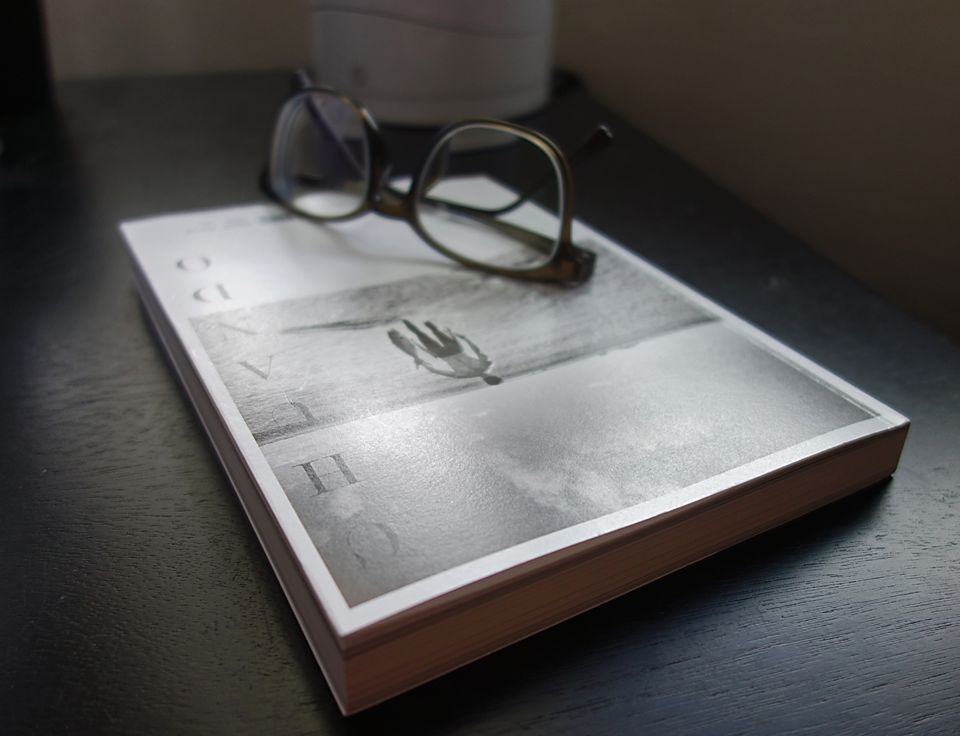
Back cover of the book
The softback reminds us of the late Godfrey Gao’s (高以翔, Gap Yixiang) first photobook (of several), 2009’s 恋爱0.01的距离 (The Distance of Love). Mr Gao was a model too, who had a natural affinity with the camera lens. He was no writer either, but his intimate phrasing and conversational style placed him in a chat with you, and you alone. He was taller than Mr Tan (1.96m vs 1.85) but his body was not defined by barbells to the extent that they begged to be ogled at, so he employed his flair for communicating with his speaking eyes and impish smile. The settings in which he was placed were cosier, which accorded the reader an intimacy that allowed reacting to his words as if there were his vocal fry. But, Mr Tan’s photos are, conversely, stand-offish, the poses a tease, viewer admiration to be made from a distance. He seems to say, just look at my body—that’s enough.
In the 224-page book, there are 106 photographs between the covers (107 pages with text, including content and section markers), of which 89 are of Mr Tan (many are repeats), and among these, 69 show him baring his chest. He certainly knows what sells. But, when most consumers of content now take in what they like online, and prefer the visual than the textual (since we remember nearly 80% of what we see, as opposed to roughly 20% of what we read), it is not clear if there is real reason or tangible demand for the book. What indeed can be drawn from paper that cannot be absorbed online? Mr Tan was first discovered on the Internet (at least in China and, subsequently, Taiwan), through his social media posts. Would his followers not continue to do so through the same medium? Is the lack of mascular content and emotional doozy immaterial to the admiration of a seemingly ageless body? To many of Tan Chuando’s admirers, he is a hunk, but his autobiography is, ironically, lightweight.
人生不需要每一次都赢 is now available at Kinokuniya. Photos: Chin Boh Kay
 Style on the Dot
A hateful piece of shit written by a resentful piece of trash.
LikeLike